Sunday, July 07, 2013

The Development of Modern Mundane Astrology


©2013 J. Lee Lehman, PhD

(Note: The material in this essay is covered in much greater detail in Chapter One of my book, Astrology of Sustainability,1)

Patrick Curry has provided a fascinating blueprint for us of the forces that shaped the development of early modern astrology, specifically through the trials (literally) and tribulations (figuratively) of Alan Leo (1860-1917).2 Briefly, Leo was the inventor of the “shilling horoscope.” Utilizing the mails through advertising in magazines, Leo created a very profitable enterprise for himself by allowing the public to send away for a horoscope, which was computed by one employee, and then fleshed out with a page on the Sun sign, a page on the Moon sign, and so forth. This style of working had both the advantage of allowing many people to explore astrology at a much reduced price, and it allowed Leo to become very wealthy through the low time commitment to each chart . Unfortunately, he ran afoul of the English fortune-telling laws. After he was indicted, and acquitted on a technicality, Leo asked his lawyer how he could prevent this in the future. His lawyer essentially said: don't tell fortunes! In an attempt to comply with at least the letter of the law, Leo removed the more predictive language of his shilling horoscopes, and changed the descriptions to character analysis: a more psycho-spiritual perspective. In the process, he also declared that this is what astrology does: its describes, not predicts. Ironically, he was then arraigned again for fortune-telling, and this time, he was convicted.

Leo's change in wording truly was a watershed moment in astrological interpretation. Leo's own private delineations showed a complete continuity with prior trends of astrological prediction. The 19th century had witnessed some simplification of astrological technique, compared to the more detailed classical methods in place through the end of the 17th century. There were the specific challenges of integrating Uranus and then Neptune into astrological usage. There were the continual questions raised by the differences between Western and Vedic astrology, a topic highlighted by the increasing interest in Indian religion by Westerners in general through the 19th century, and specifically in the Theosophical Society.

But Leo was not acting in a vacuum. The impact of these ideas hit other parts of astrology as well, not just natal interpretation. One of the easier ways to observe the change is in Leo's own astrological magazines. The ones before 1900 reflect the “old” ways, and in them, we see the earlier mix of different styles of astrology, but with a distinct predictive slant. These magazines, for example, have horary charts interpreted in a fairly conventional way. Leo's own horary examples were even collected together into a work on horary!3

But surely one of the major questions of the time would remain mundane astrology. The historical method of mundane astrology which had developed over centuries enunciated a hierarchy of charts and conjunctions to be observed: from the Great Mutation cycle of Jupiter and Saturn which lasted centuries, to the change of element (mutation) in that series of conjunctions, the individual Jupiter-Saturn conjunction, the Mars-Saturn and Jupiter-Saturn conjunctions, the Aries Ingress, and the other cardinal ingresses, lunations, and eclipses for a particular year. This series allowed the astrologer to talk about both long and short-term trends. The ancient authors had also noted the extreme difficulty in attempting to create a chart for the Jupiter-Saturn conjunctions, realizing that it was next to impossible to calculate the exact instant of the conjunction. The first time it was accepted as possible was the 17thcentury, with Kepler's and Heydon's direct observations of the Jupiter-Saturn conjunction. Even with direct observation in hand, contemporaries warned about the errors in such calculations, a worry that our modern equations confirm.4 As a result, the tendency was to delineate the Aries Ingress or lunation prior to the known conjunction, rather than the conjunctional chart itself. Astrologers living in the decades after Kepler and Heydon reverted to the ancient methods precisely because of these perceived methodological problems, which were discussed in the works of the day.

The astrologers of the 17th century were still integrating the “new” calculational advances of Kepler and the heliocentric theories, and there was serious astronomical knowledge and interest displayed by some of their numbers, such as Vincent Wing. What is hard for us to appreciate now is that their astronomical practices and equations lacked the precision that we have become accustomed to – and for good reason. Astronomical precision in observation was still a huge topic in the 17th century, following great advances by practitioners such as Tycho Brahe, and the instrument makers of Louvain. But they could still not approach the observational accuracy of mechanized instruments of both ground-based and satellite-based machines of the 20th century. But quite apart from this, different astronomical measurements have different accuracies associated with them: and any ephemeris is only as accurate as the equations used to generate it.5 One offshoot of this astronomical consideration – known, interestingly, to our 17th century forebears – is that we can obtain much more accurate results for the positions of a birth chart, than for the time of a planetary conjunction or station. In other words, the routine stuff of astrology – birth charts and horary charts – are reasonably accurate. But station times are not. It is unfortunate, but the knowledge of this simple fact is one of the things that was lost when astrology lost its university moorings at the end of the 17th century, and went largely underground for a century.

In the 19th century, astrology was dusted off, and challenged with the discovery of the outer planets. However, in mundane astrology, we can see that the job of rediscovery had worked rather well. During the U.S. Civil War, Luke Broughton (1828-1899) published the “Monthly Planetary Reader,” in which he did traditional mundane predictions of the course of the war. Broughton's method was traditionally classical, and his method seemed to work quite well, with Broughton even predicting Lincoln's assassination, and later, McKinley's.

But the 19th century also saw many astrologers experimenting with new methods. In mundane, this was partly justified by the greater globalization of the astrological enterprise. Unlike in the 17th century, the telegraph and faster ships brought news of foreign politics and wars more quickly to a public that became used to hearing of events on distant shores.

One of the astrologers who helped to pioneer this transition was Sepharial (1864-1929). In his columns on monthly events, he transformed mundane astrology in a number of ways. We can summarize his methodology as follows:

  • The sign placements of the planets have replaced any celestial conjunction as the top headline. This allowed him to predict that these planets would affect countries ruled that sign.
  • He reduced the Mars-Saturn conjunction to a mere transit, instead of an event worth analyzing in its own right.
  • He did discuss lunations, but his discussion was mainly of planetary conjunctions or aspects occurring in the chart, but these conjunctions are largely inferior conjunctions to superior planet configurations already in play.

Sepharial wrote specifically on the interpretation of the Jupiter-Saturn Conjunction in Transits and Planetary Periods. In fact, this work should be seen as the genesis of the methods of working with the Jupiter-Saturn conjunction still being used in the 1920s and 1930s. In this work, he developed a system for working with the conjunctional chart, and then following it through time with secondary progressions or directions. Sadly, this work showed no knowledge of the problems in calculation associated with attempting to arrive at a chart of this nature.6

One obvious change that had to be addressed in the modern period was the discovery of yet more superior planets, thereby adding more transits to the mix..

And I have to wonder whether the shift in Sepharial's interpretations to the use of signs as being part of an attempt to re-envision how to get the “where” right. This seems transitional to astrocartography, but unfortunately, the emphasis on sign seems to have stuck as much for its convenience in generating copy for monthly deadlines than for producing real predictive power.

The methods that Sepharial was beginning to experiment with for approaching mundane as a truly global art only needed reinforcing as time went on. World War I (the Great War, as it was styled before World War II imposed a numbering system) was fought globally. The emergence of new world powers continued to challenge capabilities of astrology to keep up with globalization.

Between the wars, we can use the Astrological Quarterly to understand these developments. The Editor, Charles Carter, wrote extensively on mundane, and there were contributions by others as well.
A good example was L. Protheroe Smith, entitled “The Year 1927,” which featured the Jupiter-Saturn conjunction of 1921.7 He begins his article by saying:

“I make no apology for once more drawing your attention to the forgoing figure, for the conjunction of Jupiter and Saturn in the year 1921. I have discussed it here before, and I shall do so again whenever I am asked to speak on National Astrology during the period over which it rules. Because, although perhaps less is known concerning this branch of our work than almost any other, yet there is reason to believe that national destiny runs in cycles; and we get, I think, a glimpse of this cyclical process in the Jupiter-Saturn conjunctions which recur at intervals of approximately 20 years.” (page 4)

So far, this could have been written by Masha' Allah – except for the phrase “national destiny.” We have moved into the period of democracies and other governmental forms, where the Head of State may only last in that role for a few years – rarely for life.

However, a close examination of the article reveals major differences. First of all, his year is a calendar year: not a year as defined by the Aries Ingress. In fact, there are no cardinal ingresses to be seen at all! What is present is a chart purporting to be for the exact moment of the conjunction – something we have already seen has some serious astronomical challenges associated with it.

His chart comes out to approximately 45 minutes off our modern calculation! How can this be? There are two components to the problem:
  • In the era before the computer, the accuracy of planetary positions in an ephemeris was not as high as now. This is the major source of the error in Protheroe-Smith's case.
  • Trying to come up with the exact moment of a slow conjunction such as this from an old ephemeris, which gives static positions for each day, is truly impossible. Positions were given to the nearest minute. You can't just interpolate the exact moment, because a minute isn't sufficiently accurate for a body that only moves a few minutes per day! Is that position of 1 degree 56 minutes really 56 minutes, or 55.51, or 56.49 minutes? You don't know! You can even see whether your current computer program has conquered this problem by comparing a timed transit list to using the ephemeris generator to see if you get the same time!

But the chart published has the deceptive appearance of correctness, because both Jupiter and Saturn are in the same minute of arc. Jupiter was moving by 13' per day, and Saturn by 7' – this is a good illustration of the degree of uncertainty of these conjunction charts – and exactly why Vincent Wing warned about this problem over two centuries earlier. Uncertainty by twelve hours wrecks havoc with the houses! So we must begin by being suspicious of anything he says about the Jupiter-Saturn that is house-based.

Since he is not using ingresses, or eclipses, or lunations, what is he doing to predict 1927? Why, he's progressing this already suspect Jupiter-Saturn conjunctional chart, using the method pioneered by Sepharial!

Secondary progressions did not exist until the 17th c. when Placidus invented them in an attempt to reproduce Ptolemy's method of directing. I don't object to their use here because they are new. The genesis of the idea for doing something like this exists in the classical material, which mentions directing revolutionary charts – although this would have been by primary direction. But if the method is going to shift, it's important to test it out. How can one test it out on a chart which is already suspicious?

Protheroe Smith used the progression to focus on the progressed Moon, by sign and house placement. He also does transits from the year to the progressed placements, and aspects of the progressed Moon to the dubious conjunctional chart.

I should mention that Protheroe Smith's articles continued to grace the Quarterly for some years to come. And both he and his editor clearly believed that he was getting good results from such a tenuous method. How can this be? This methodological problem does not negate transits by themselves, nor does it negate the importance of the planetary placements at the time of the Jupiter-Saturn conjunction itself – a conjunction Protheroe Smith clearly had come to know intimately. Later, Carter would present the “new” Jupiter-Saturn conjunction for 1940 during the war – and again, it would be inaccurate, though not so much as the 1920 one. However, but then, Carter had severely reduced his discussion of it, suggesting that, on some level, he had realized that it was not the major predictor that it was believed to be in 1927!

In the same issue, “Taurus” reported on the total eclipse, visible in London on 29 June 1927.8 After a review of the astronomy, the eclipse was interpreted astrologically, using aspect patterns. Planets are used exclusively through their house positions: no house rulerships are noted at all.

There clearly was a lot of experimentation going on, in many respects paralleling the development of modern natal astrology, with its simplification of the ancient systems, along with a much heightened dependence upon the aspect patterns as the primary method of delineation.

From here, we can pick up the history as it is presented in Baigent, Campion, and Harvey. As Nicholas Campion pointed out in his chapter, “The National Horoscope: Mundane Astrology and Political Theory,” the current modern reliance on the national horoscope is quite new. It was impossible in Europe until only a few centuries ago, with the development of the modern state.9 He also discusses the relationship of the state to the national leader, “the birth chart of the leader becomes a working horoscope for the collective” (page 109). As Campion has pointed out elsewhere, the development of the national horoscope as a preferred method for the analysis of mundane effects came in the wake of the failure of British astrologers to predict World War II. We can see it in use in the lead-up as well, witness C.E.O. Carter's references to a chart for the Fascist Regime and to the French Republic in the March-April-May 1939 issue of the Quarterly.10 The theory has been presented that incorrect predictions by R.H. Naylor and others concerning the war led to a wholesale re-evaluation of mundane methods, leading to two primary developments:

  1. Greater utilization of national charts to pinpoint hot spots
  2. Work by Barbault and Gouchon initially, then buttressed by Baigent, Campion, and Harvey to elaborate the meanings of the new superior planet cycles involving Uranus, Neptune, and Pluto.

While this is undoubtedly true, I suggest also examining a chart for the Aries Ingress 1939 shown here.


Figure 1. Aries Ingress 1939, calculated for Berlin and London.

Either way you cut it, an Aries Ingress with Mars exalted in a partile square to the Sun looks like a war. And yet, in an article in the Quarterly by Estelle Gardner entitled “National Astrology,” she reviews that chart – and does not so much as mention the word “war.” Doing the chart for London, she merely remarks that the Pluto Rising may denote the association of Pluto with National Socialism and Fascism!1 How did she miss this? It's worth remembering that England at this time was strongly neutral and anti-war. There was also a significant political faction favoring the Nazis. One sure-fire way to mess up your predictions is to hold too dearly to your own pet theory of How Things Are. If you cannot imagine war, then you cannot predict it either.

Charles Carter himself joined in the prediction of “no-war-in-1939!” in the June-July-August 1939 issue of the Quarterly, using as his evidence the Jupiter-Saturn conjunction for 1901 – a chart which is as flawed in its calculation as the 1921 chart that I discussed in relation to Protheroe Smith's article. Then, adhering to the same method, Carter used secondaries to progress the chart to 1939, divining easy aspects for the immediate future.2 And yet, in his following Editorial that he wrote on August 1st, he said:

“I am writing this on the first day of August, with the atmosphere around me somewhat milder (under the influence of Jupiter stationary) than it was a few weeks ago (under Mars stationary). Nevertheless there is a widespread belief that things will move rapidly and dangerously at least or about the end of the month. And the August lunation is a strange one; Sun and Moon rise at Berlin, square Uranus in M.C.”3

It would seem that the sudden beginning of the invasion of Poland looked exactly like that lunation. It was only strange if you couldn't envision war as the meaning. What failed the British astrologers was not the ancient techniques, but Sepharial's modification of them, combined with unwillingness to interpret what they were seeing, but wouldn't countenance.

Discussion


It's difficult to impossible to predict what you cannot imagine happening. Carter's words were split: when he used Protheroe Smith's methods, the result he got suggested “no war.” But the chart for the lunation itself as well as the Aries Ingress showed what was in fact the correct answer – but the inconvenient one. It was not the old method that failed, but the new one.

Unfortunately, there has been too much of a trend in astrology to not worry much about the astronomy of what we do. Here, clearly, the British astrologers did not want to worry about the precision of Sepharial's method. Today, it is still true that finding the precise instant of a conjunction or other aspect is difficult, and so even now, attempting a chart for an outer planet aspect has its pitfalls.

It is also troubling to note that the method that failed was a new one: but that did not seem to be the take-home lesson. Yes, Sepharial's method did eventually disappear, but was this acknowledgement of the failure, or Planck's Principle, by which a theory doesn't die out until its adherents do? In the fourth issue of the Quarterly for 1939, now with the Germans already on the move, Carter predicted the end of the War in 1941, In this prediction, he was still referring to the bogus 1921 Jupiter-Saturn chart. Carter referred extensively to charts of the various countries involved, or of the heads of state in the absence of a country chart, while bemoaning the absence of a chart for Britain (he explicitly rejected the UK chart for 1801). He suggested a new system of symbolic directions based on a passage from Isiah which would have resulted in mortal peril for Hitler in less than a year. In a list of charts relevant to the study of the war, Carter included the mutation chart (not great mutation, as he stated) of the Jupiter-Saturn conjunction of 1842, when the conjunction series moved into Earth. Again, the problems with the calculation of the precise moment of the conjunction meant that the chart has the wrong Ascendant and MC by a sign, once again weakening the chart considerably as a predictor of the future. We should mention that Carter's charts did have Pluto marked in them, so he was attempting to include Pluto as well.

Carter did circumspectly predict the entry of the USA into the war after November 10, 1941, based upon the station of Mars, but herein lies another tale. He was right: 7 December 1941 marked the entry of the USA as a result of the attack at Pearl Harbor, But again, the astronomy was a problem. Carter stated that this station would occur with Mars conjunct the Ascendant in Washington, but a modern rendition gives Mars conjunct the Descendant – not a bad symbol for the attack by Japan (=7th house, enemy of the USA), but again. We see how accuracy was being hampered by astronomical factors. In the same issue (September-October-November 1941; written approximately August), Carter reiterated his prediction for the war ending in 1942, this time based upon secondary progressions of the chart of Britain, Italy, Mussolini, Hitler, and of the German Empire.

By 1942, Carter had realized how difficult the job of prediction had become:

“If publication grows more difficult [referring to paper rationing], so also does prediction. We have now six or seven Great Powers actively engaged in hostilities, for the most part on several fronts, and there are a number of lesser belligerents on each side. Thus the outlook is becoming ever more complex, with good and bad features interwoven and helpful and harmful periods in quick succession.” (Vol. 16(1): 1).

Part of the desire for better charts for countries and heads of state rested on a simple fact of geography applied astrologically: the chart for an ingress, eclipse, or lunation was not substantially different in London or Berlin because the two capitals are simply not far enough apart to make it so. And this was always the challenge with Europe: comparatively small states mean that relocation of a chart for the different countries results in similar charts, even when the countries are experiencing substantially different outcomes. What to do? This was actually why Carter was so concerned about having country charts or charts of the ruler – the geography demanded the approach. But then, confronted with grand alliances of multiple countries, the complexity of the situation became overwhelming.

I have to feel for Carter. Reading the entries through 1943 and into 1944, this had to have been wearing on him. One almost gets the sense he was ready to return to any other kind of astrology – as I'm sure all his readers were equally ready to return to their lives without war. Could this be a factor in why he missed D-Day in June 1944? Remember that Carter was prognosticating based on the New Moons only: D-Day was planned for the Full Moon. For May, Carter had said this:

“The Gemini ingress shows Pluto setting at Washington, still supported by Uranus – an indication of heavy fighting.... The lunation, on the 22nd [of May], is trine Neptune but falls in the 12th at London, with Saturn just risen. It seems an uninteresting figure, but Jupiter is on the cusp 3 (Campanus), which may do something to mitigate traveling conditions and the paper shortage.”4

We shall consider just how “uninteresting” this figure is in a moment, but let's also see Carter's predictions for June. Because of his use of New Moons, this refers to after D-Day, but of course what D-Day did was to open fighting on another front, which certainly did increase the amount of it:

“The New Moon falls, on the 20th, in 29 Gemini, between Venus and Saturn, being also square to Neptune.

“It does not seem an outstandingly important figure for us, but at Washington Venus is on the midheaven, with the Lights and Saturn near by. A brilliant position but for Saturn, yet nevertheless calculated on the whole to bring some eminent success to our Allies.”5

Let's reconsider these charts, and see whether Carter actually missed anything.


We should remind ourselves that the planning for D-Day was massive, and that the staging was happening in England, even if much of the operation was American, and it was under the command of American General Eisenhower. And foremost in that planning was secrecy and deception – certainly Neptune, if we choose to use an Outer planet! And talk about deception! General Patton was assigned as leader of the completely fictitious First US Army Group, while really secretly commanding the brand new and barely trained Third Army, which would be deployed after the initial D-Day landing. Patton's bogus Group was the decoy to make the Germans believe that the inevitable assault would occur other than where it in fact did. So the lunation partile trine Neptune is extremely descriptive of what was going on – but in a way that Carter could not possibly have realized at the time. Score One for Carter noting the Neptune – we leave the details to “stranger than truth.”

However, there are factors which we may note that were not of Carter's early modern approach to delineation. We note the position of Mars at 29 degrees of Cancer conjunct the benefic North Node, in the 2nd house. Let's pull this apart. First, the use of out-of-sign aspects explicitly goes back to the Arabs. Secondly, let's consider Mars more closely. The sports prediction work I did with Bernadette Brady demonstrated that the malefics in Fall and Detriment are much more dangerous in a contest (and hence war) than the other placements – we can consider these positions super-charged. Now, that is obviously not a piece of information that Carter had access to in his day. However, it is odd that he ignored Mars in a critical degree – the 29th. Furthermore, the 2nd house is especially important, because in conflict charts, the 2nd house is like your second in a duel: it's your allies, those fighting on your behalf.1 So here are the Americans on British soil, staging the largest mobilization of troops in history for an invasion, so how can this not be 2nd house?

D-Day was scheduled for June 5th, but was delayed one day because of weather. At the Full Moon on June 6th, the invasion began. Here at the MC for the lunation is Neptune. The entire Allied plan hinged on the Nazis believing that the invasion would occur in a different place than it did, so that the troops could get ashore without being bombed immediately into their graves. The Ruler of the Ascendant was Jupiter, in in-sect Triplicity, cadent, but in an appropriate house for foreign invasion, the 9th. Also, repeatedly, classical sources reiterate that the 3rd-9th axis is less malefic and stronger than the 6th-12th. Meanwhile, Mercury, ruling the enemy, is peregrine and in the 6th house – truly a bad position. The army of Britain's Ally was Saturn – and Saturn was in a dangerous position, the 7th house, but dignified by Triplicity. Among the key words I had established for Triplicity is precisely luck – and the Americans that night had the luck – the luck that their Neptunian ruse had worked and the weather held!

All of the strategic planning of the Allies had suggested that if the beachhead was successful, then the rest of the plan was, if not easy, at least carrying an acceptable probability of success. By the New Moon in June, this next phase was well under way. In Carter's analysis, the period of D-Day had actually fallen under his May predictions, and he had already discussed those retrospectively in the same issue in which he gave June prospectively. He did note in the retrospective discussion that Mars going through Leo should affect France, Romania, and Italy – which certainly was true.

As we examine the New Moon for June 20th, we may add some features that Carter did not discuss. The combined Allied army is given by Mars, not exactly strong by dignity, but applying to the benefic Jupiter, which was in Triplicity, and thus strong enough to aid Mars. Mars is separating from Pluto, perhaps the signature of that very fragile and dangerous moment when the troops hit the shore. Meanwhile Venus, ruling the Axis army, is peregrine, in the 8th house, and combust!

Carter himself acknowledged that he had not forecast this with his comments in the following issue:

“On the 6th (a day later than originally planned, because of the weather) the invasion of Normandy began. I can make no claim to have foreseen this momentous event, though obviously a time when there were two powerful and violent conjunctions in the heavens [Mars-Pluto and Venus-Uranus] was appropriate enough for a hazardous and audacious undertaking.”2

After D-Day, the war proceeded apace, looking ever more grim for the Axis. And it is indeed by this time of November 6, 1944, the revision date of his article, that events seemed to be coming to a close. The Soviets were progressing through Eastern Europe. The Allied armies had reached the Western boundary of Germany, with the free French fighting their way East to the Rhine. Athens was liberated; Rommel was dead. However, Carter was now hedging his bets a bit. In referring to the Aries Ingress 1945, he said:

“At Tokio Pluto is on the nadir, depicting defeat. But I look to 1946, so far as one can judge from the Mikado's geniture and epoch, for the total Japanese collapse.

“Unhappily, this ingress is evil for the United States. Neptune is just below the ascendant, in quadriture to Saturn just past the midheaven. This formation seems to point to very difficult times indeed. In a sense, this agrees with our belief that the European war will end under or even before the time of, this ingress.”3


Carter was off by quite a margin on Japan, and his V-E prediction was vague. This ingress, or before? His negativity about the US suggests before, so the “during” part (which turned out to be right) seemed more like hedging. Actually, the negativity was a good call, because that period represented the death of President Franklin Roosevelt. He correctly noted that the lunation for April in Berlin looked bad for the Germans, and commented about whether the capital would even stay there, presumably because of the extent of Allied penetration into Germany. He then noted that the April and May lunations did not look good for London, and that May looked bad for Washington. Accordingly, he missed entirely V-E (Victory in Europe) Day May 8th, barely a week after Hitler had committed suicide.

Why did he miss it? There's one chart he never referred to throughout his long years of these prognostications: the Aries Ingress for 1939, the year it all began. If we add that chart to the Aries Ingress charts for 1945 that Carter discussed, we can see something about why this particular ingress was so important.


For that fateful Aries Ingress in Berlin in 1939, Saturn in Aries culminated. As I mentioned, the malefics in the signs of their Detriments and Falls are extremely strong when it comes to combat and destruction. Saturn's Fall is Mars' ruling sign, just as Mars' Detriment in Libra is Saturn's Exaltation. So this is an extremely belligerent Saturn in Aries – poised to do damage. But it isn't quite time yet: Pluto is at 29 Cancer, just on the brink of changing signs, and Mars is happy in its Exaltation. However, the partile square of Mars and the Sun really sets up the very dangerous pattern that is already ready to leap out of this chart. This Aries Ingress is just a few hours after a New Moon, with the Moon still combust. The focus of the 9th house is on foreign affairs, and the tone is martial.

But there is a warning in this chart. Saturn rules the enemy: the 7th house. That Saturn ruling the enemy is stronger than the Sun: they are matched by points (+4 for the Sun in Exaltation; -4 for the Sun in Fall; the points represent the strength, and they are equally strong, if in opposite directions). But Saturn is a superior, and it is culminating, the angularity making it much stronger than the Sun. Thus, the chart says that if Germany initiates a war during this period, then they will lose. And Germany did, because the fixed sign rising means that this Aries Ingress was the only one needed to interpret the year.

Let's compare the Aries Ingress for 1945 to 1939. First, when we compare the positions for Berlin and for London in 1945, we see the focus of activity is Berlin. London had Jupiter conjunct the MC: the Greater Benefic, but in questionable condition, being in Detriment and retrograde. So it's good, BUT... In Berlin, The Sun-Neptune opposition is very close to the MC/IC axis, with Uranus at the Descendant. But it is when we compare to 1939 that we really see how much more significant this highly angular chart is. 1945 Saturn has come almost to the square of 1939 Moon. In 1945, Moon is in an approaching conjunction to Saturn. This conjunction is occurring very close to the 8th house cusp – death. Jupiter is almost exactly opposite its 1939 position; and 1945 Mercury is within a degree of 1939 Mercury. These kind of resonance patterns are very important in the study of returns – a topic I discussed at length in Classical Solar Returns, although Ramesey applied the same ideas with mundane returns.1 Resonances of same signs or opposite signs bring the relationships together and emphasize the importance of the year.

In Carter's retrospective analysis of VE Day, he mentioned that the chart he was using for Germany had Saturn at 4 Capricorn. We see this degree important in both the 1939 and 1945 charts, so it does seem odd that his interpretation in advance was not a bit more firm. In his next installment of predictions, he correctly spotted the danger to Churchill's position as Prime Minister right after the conclusion of the War because of the solar eclipse of July 9th, which he also noted adversely affected the Japanese emperor. This was the final installment of the “Month to Month” mundane predictions that had evolved during the war.

It goes without saying that it is much more difficult to work in real time as Carter did, than to explain the outcome after the fact. But I have already mentioned the 19th century astrologer Luke Broughton. Broughton published a monthly magazine during the American Civil War in which he made monthly wartime predictions using the cardinal ingresses, eclipses, and lunations.

Given the methodology, there is much in common between Broughton's and Carter's methods. But there is also a considerable difference: Broughton used classical methods fairly strictly, whereas Carter did not use them at all.

When I discovered Broughton's work on the Civil War some fifteen years ago, rather than publishing a detailed discussion such as this, I saved the example to be used by my mundane students. There is nothing like comparing predictions to actual results to develop an appreciation for the techniques that produce, and those that don't. Broughton did work with the charts of the generals of both sides of the War, but generally, he had only birth dates, not birth times. So mostly, he stuck to the usual mundane charts. His accuracy seemed to be somewhat better than Carter's, but we must admit that the complexity of alliances and a much larger global theater had to make Carter's job more difficult.

In an editorial in 1945, Carter said:

“Most astrologers probably possess Zadkiel's Grammar, published in 1910 by G. Bell & Sons together with Lilly's Introduction;...”2

This simple statement reminds us of something amazingly important. While modern students of Lilly reject that particular version as an unfortunate abridgment, Carter's reference to its ubiquity reminds us that through the 1940's, just about every serious student of astrology in Britain if not other English-speaking countries had a decent, if not wonderful, introduction to classical methods sitting right on their bookshelves. The obvious question is, why didn't these people pay more attention to what they had?

We have seen repeatedly how adding back some classical method through house rulerships and dignity added to the accuracy of the interpretation. So why didn't they see it? Earlier, we saw that Carter referred to Ramesey's rules of elections, which means that he had access to Ramesey's work on mundane in the very same volume. Carter showed evidence that he indeed knew this material: for example, his reference to the cardinal sign rising for the Aries Ingress 1945 in Washington DC denoting a duration for the effects of only one quarter.3 Here was even more detail about mundane methods that Carter again ignored. Why?

I can only conclude that Carter and his contemporaries were so seduced by Sepharial's re-packaging of mundane astrology that they didn't critically examine which pieces of their system were working, and which weren't. Again, thinking of the prospect of doing all these hand calculations, not to mention attempting to follow so many charts manually itself provided an almost insurmountable task.

However, if the lesson that Carter Et Al “learned” from the war was that the old method didn't work, then they learned the wrong lessons. In one sense, we could almost say that the real “old methods” hadn't been tried!

-------

1Lehman, J. Lee. Classical Solar Returns. Atglen, PA: Schiffer Press, 2012.
2Vol 19(1):1.
3Vol. 19(1):6. The reference in Ramesey is: Ramesey, William. Astrologia Restaurata, or, Astrologie Restored Being an Introduction to the General and Chief Part of the Language of the Stars : In 4 Books ... : With a Table of the Most Material Things Therein Contained. London: Printed for Robert, 1654, p. 215.


1See, for example: Partridge, John. Mikropanastron, or, an Astrological Vade Mecum Briefly Teaching the Whole Art of Astrology, Viz. Questions, Nativities, with All Its Parts, and the Whole Doctrine of Elections, Never So Comprised, nor Compiled before, So That the Young Student May Learn as Much Here as in the Great Volumes of Guido, Haly or Origanus. microform. Printed for William Bromwich ... London, 1679, p. 42.
2Vol. 18(3): 67.
3Vol. 18(4): 89.


1Gardner, Estelle. National Astrology. Astrological Quarterly, Vol 13, No 1, 1939, pp 3-8.
2Carter, C.E.O. Editorial. Astrological Quarterly, Vol 13, No 2, pp 45-47.
3Carter, C.E.O. Editorial. Astrological Quarterly, Vol 13, No 3, p 89.
4Vol. 18(1): 8.
5Vol 18(2): 37 (written May 14, 1944).


2Curry, P. (1992). A confusion of prophets : Victorian and Edwardian astrology. London, Collins & Brown, Chapter 5.
3Leo, A. (1907). Horary Astrology. London, Fowler.
5An absolutely critical discussion of this is found in Mark Pottenger's article, “Accuracy of Astrological Calculation,” pp. 159-176 in Pottenger, Mark, Editor. Astrological Research Methods Volume I: An Isar Anthology (Vol. I). . Los Angeles: International Society for Astrological Research, 1995.
6 Sepharial. Transits and Planetary Periods; a Book of Practical Hints to Students of Astrology. New York,: S. Weiser, 1970, pp 70-81.
7Astrological Quarterly, Vol. 1, No. 2, pp 4-11.
8 Astrological Quarterly, Vol. 1, No. 3., pp 29-33..
9 Baigent, Michael, Nicholas Campion, and Charles Harvey. Mundane Astrology. An Aquarian Astrology Handbook. Wellingborough, Northamptonshire: Aquarian Press, 1984. The chapter referred to is pp 95-111.
10P 1.

Monday, March 11, 2013

The 2005 and the 2013 Papal Conclaves: A Mundane Exercise

©2013 J. Lee Lehman

Once again, speculation is rife, and astrologers are trying to sort through the possibilities for the new pope, just like everyone else. Following so soon after the 2012 USA presidential election cycle, I can't miss noticing some of the same feeding frenzy - and quite possibly, some of the same mistakes made then.

Perhaps the biggest mistake, imho, is the continued attempt to use horary in order to predict the result. I am going to repeat what I said at the time of the election: to get a good horary requires intimate personal involvement in the outcome, and simply being a news junkie is not enough. Then there is the obvious admonition about not asking the same question twice. It is simply inconceivable that all billion or so possible horaries would come to the same conclusion.

We are in the land of mundane, folks, so let's try to understand how to answer these questions using the right tools. And the best place to start is to look at the last papal conclave in 2005.

We actually have reported data for the dramatic moment when the doors to the Sistine Chapel were closed, closing in the cardinal electors. Here is our chart.

The first thing to notice about this chart is that there is a cardinal sign on the Ascendant. Going back at least as far as Dorotheus, this tells us that this Conclave will take less time than average. The interesting thing about the structure of a Conclave is that the usual format is that the Cardinals go in, and elect one of their own. As an event, it is the cardinal electors given by the 1st house: they are the movers of these events. They are electing the 10th house pope. So in this chart for 2005, we see the cardinals represented by Venus, Ruler of the 1st, dignified in Taurus. The future pope is given by the Moon ruling the 10th. The Moon in Virgo: perhaps a writer, an engineering type, an introvert - all possible renditions. But perhaps the most significant signature is that the Moon is coming to Venus by trine in one degree - and the new pope was elected within a day of the beginning of the conclave. What is perhaps most amazing about this is that Pope John Paul II had updated the papal election procedures, and the newer version has made the living arrangements during the Conclave much more comfortable - something that, it might be argued, could have made it easier for the Conclave to last longer. But it didn't!

We should note: the chart for the start of the Conclave is not the same as the start of the Papacy: it is the chart for the election itself. It is the other relevant mundane charts that begin to show us what were the issues of Benedict's reign.


Here we see the Aries Ingress before Benedict's election. The first and perhaps biggest point is that this chart covers both the death of John Paul II and the ascent of Benedict XVI. Here we are immediately struck by the partile Moon-Mars opposition so close to the Ascendant-Descendant. These cusps themselves are the Gates of Life and Death, as originally formulated by the Greek astrologers. The Moon, ever ready to show the action in a chart is opposite Mars, Ruler of the 10th. What is so fascinating about this is that Joseph Ratzinger was of the nature of Mars: a true defender of the faith. John Paul II was noted for his involvement with the Marian aspects of Chrsitian faith, surely more lunar in nature.

Both the Moon and Mars are highly dignified here with Mars having both exaltation and Triplicity. But they are at the 29th degree: the old order is changing in this moment, and the new pope being elected is very much of the old order.

Mars' rulership of the MC, and just having set below the horizon guarantees that this papacy will be marked by struggles relating to past issues, and that thes struggles can have the effect of diminishing the Church.


Consider next the lunation before the 2005 Conclave. Here we see the signature of what was perhaps the biggest problem of Benedict's reign: the seemingly unending litany of sexual scandals. How can we be surprised with the New Moon in Aries in the 5th house of sex, conjunct Venus in Detriment, and with the North Node there to blow up the circumstances? Here we see the new Pope, Mercury as in the Conclave chart, in Aries - his tongue was sharp enough when he spoke of the problems, but he looks completely ineffectual in this chart.

We might also contemplate Pluto in the 2nd house with a retrograde Ruler Jupiter in partile trine to Neptune to represent the banking scandal.

But enough of the past, what does the current Conclave chart say? [The following is a change to the original text posted last night.] The cardinals filed into the Sistine Chapel with Mercury still angular, but ruling the Ascendant and MC, and Jupiter in the 10th. As they completed their chanting, oaths, and other preliminaries, both Neptune and Mercury, set, and Jupiter moved from the 10th to the 9th. Jupiter in the 9th is appropriate for an ecclesiastical event: and I have to say it is more descriptive that a private meeting have so much more of a cadent look. Jupiter is still angular, though, being still conjunct the MC. Some ancient sources have distinguished between the 3rd-9th axis and the 6th-12th axis, finding the 6th-12th to be much more malefic - which makes sense under normal conditions, but so much more so for a religious occasion. 

I took the closing of the doors at 5:34 pm Vatican time. This Conclave will be of average length, the general meaning of mutable angles. There's a very strong Mercury signature, with Mercury ruling both 1st and 10th. And poor Mercury! In Detriment, in Fall, cadent, and retrograde. The importance of Mercury at this time cannot be overemphasized! I have to wonder whether this chart would grant a pope even remotely able to tackle the very serious issues facing the Church. Neptune can represent great faith: but also great blindness. As the procession was occurring the Daily Telegraph reported on the arrest of a Colombian priest in California for child battery, showing all too clearly the problems of the Church today.

The Jupiter dispositorship suggests that the new Pope will surely be a man of great faith and conviction, because that is what Jupiter represents. But Jupiter is in Gemini - its own Detriment - so again, I would worry that this man will not be entirely up to the task.

I would also not be surprised to see this Conclave run until Mercury stations direct, given the strong Mercury rulership shown. Retrograde Mercury is applying to Neptune: but in the moment of turning direct, it refrains from conjoining Neptune, which itself is perhaps the biggest hopeful sign we can muster.


Thursday, February 07, 2013

Is the Astrology World ready for Linux?

©2013 J. Lee Lehman

Linux?

Back when I was relatively new in the computer consulting world, many of my installations were in Unix. Unix is a stately old operating system with a solid university backing to its lineage that was designed for a multi-user environment. In fact, back then, people didn't have pc's on their desks: they had dumb terminals. A Unix design allowed even a relatively small business to have the luxury of a true multi-user environment, where different employees shared data between inventory, order processing, billing, payroll, and accounts receivable. Most desks had an IBM Selectric typewriter on one side, and a terminal on the main desk.

Unix was fun for me, and I loved coding database designs. But that was then. After I had been doing that for maybe ten years, the Windows operating system arrived, and the typewriters were on the way out. Networking became the name of the game, and I lost interest, because I didn't like the new databases for pc's. And a good thing, because my astrology business had grown to the point where I had to choose one.

But all these years later, I still reserve a soft spot in my heart for the simplicity of Unix that Windows obscured. All those jokes about Microsoft: like the one about if the Windows operating system ran our cars, they would stop randomly in the middle of the road - and nobody would complain. But still, I stuck with Microsoft for the simple reason that all the astrology programs of any complexity were native to Windows. Sigh.

Then along came Linux. I hadn't really kept up enough to follow its trajectory at first. Call it inertia: I had all these other things to think about, like which Triplicity table to use, and which way to calculate the Ruler of the Nativity. But every release of Windows, I groaned. It became clear to me that the operating system new editions, like much of the established software upgrades, were artificial cycles designed to keep the corporation's balance sheets humming, not mine.

About four years ago, after some encouraging words from my brother, I decided to get my feet wet in SUSE Linux. Mistake. No matter how much I had been hearing about open standards, the installation packaging left so much to be desired that I quit after about a week of frustration. But I still remembered the hype: Linux is fast, Linux is free, Linux is open source. Sigh.

Several months ago, my partner Maggie Meister reminded me about Linux again. At first, I groaned. I don't have time for any big learning curve! But then I made contact with a gentleman who is writing a new software program for classical astrology using Xbuntu, and so my curiosity was peaked.

I started reading on Ubuntu, which is a flavor of Linux. (Xbuntu is Ubuntu with a different desktop; in the Linux world, such fracturing is possible and yet everybody stays friends.)

Unlike many open source scenarios, Ubuntu has some serious money behind it, because Mark Shuttleworth, after making mega$ online, put some of that money back into developing a flavor of Linux that would work for the rest of us. This has translated to regular operating system upgrades, the writing of all the background stuff like hardware drivers, and not least, the development and implementation of the vision for a Linux for all of us.

So I was psyched, but I also remembered my disaster with SUSE. I had discovered that both Dell and Toshiba have made their product lines Linux compliant, and that many other hardware companies have done the same, at least with some of their models. So after much thought, I decided to buy my hardware from a Linux specialist: the machine would come with Linux already installed, and so I wouldn't have to sweat over things like getting the wifi up and running, which was one of the things that had utterly defeated me on SUSE.

In less than a week, my machine arrived, and then I only had to wait for the time I elected that evening to start it up! Right away, I was online, running Firefox (my preferred browser for years), running Libra Office (a sister to Open Office that is completely open source; Open Office had been my go-to for years), and going through the check-list of programs that I had created to map out which programs were cross-platform available, and how I would proceed with the conversion. Skype, Dropbox, Audacity, and Evernotes were some of the applications that were already available in Linux editions - although Evernotes is actually a Linux special work-around called Everpad.

My first goal was to eliminate the Windows 7 computer on my desk, and I accomplished that within two days. I am composing this on the Ubuntu machine with an XP netbook to my left, in the alternate computer place. A week later, I still have not turned off the XP. However, I probably will within the month.

This blog entry is to detail how I got there, what you need to know, and whether it's worth it.

First: I am very happy on Linux. It is for real much faster than Windows. The Ubuntu interface is enough like a cross between Windows and Mac to have a familiarity about running it that allows the user to get pretty far without having to look things up. I did purchase The Official Ubuntu Book (7th Edition), and I have been working my way through it - and it has been very helpful.

One of the first things I fell in love with was the four desktops. Yep. I've generally tended to have a whole bunch of programs running: e-mail, Firefox, accounting, Sirius, Solar Fire, Solar Spark, possibly one or more other astrology programs, not to mention word processing, possibly a database or spreadsheet,a presentation program, and maybe a audio or video program. What a mess! Now my projects are split out between four regions which are switchable through Ubuntu-S (yes, being an Ubuntu machine, I don't have a Windows key, but an Ubuntu one). So now, astrology is on one desktop, the Internet on another, my sound editor and presentation program on the third....

But: is this ready for astrology prime time for someone without a Unix pedigree? My answer is: it depends. If your primary program is Sirius, Kepler, or Nova Chartwheels, the answer is: yes. If your primary program is Solar Fire, then the answer is: maybe. And what follows is why there is a difference.

Crossover

 A long time ago, Linux people realized that there were a lot of programs on Windows that Windows alums would quite justifiably want to maintain under Linux. And thus, wine was born. In Linux, wine is not a drink, but a platform to fool a Windows program into believing that it's really loaded on a Windows system. Wine creates a bottle in which it takes the Windows program's outputs and inputs and translates them into calls that Linux understands. The thing is, wine can be pretty tricky to implement.

Enter Crossover. Crossover is a program by Code Weavers that automates much of the wine process so well that if you have copied over a Windows .exe or other program file, or you put a Windows installation cd in your cd player, Crossover will very nicely ask if you would like it to try to install the program. I used Crossover to install Microsoft Office 2007, Sirius, AstroTides, my e-mail program (Thunderbird comes installed), and a whole host of utility programs. Crossover also runs on Mac's.

Here are some of those results.


 What you see above is Sirius, from Cosmic Patterns. You also see a desktop view with a couple of features. Ubuntu has something they call the Unity interface: you see on the left side a series of icons: these are the common programs and procedures. Unlike a Windows desktop, these icons are always in view to the far left.

The only problem I had loading Sirus through Crossover is that the Sirius installation is a two-cd operation, and that is currently flaky in Crossover: I solved this by installing in Windows, and then copying it over.

This also brought up an issue which is generally true in Crossover bottles: the issue of multiple windows within a program. When you ask for a new chart, Sirius pops up a data entry window. It's very easy for the entry window (which is smaller) to get "trapped" behind the main window.

In the background of the Sirius window, you will see a couple of file manager programs. Linux has file management similar to Windows (actually, of course, the Unix architecture predates Windows), but one of the commands in common is ALT-Tab for switching between programs: something I probably used every day of my Windows life. ALT-TAB has an extra feature in Linux: if you hold it down on a program icon, it will then allow you to switch between the open windows within a program - a very handy feature. If I was doing data entry in Sirius, then get interrupted by a phone call or e-mail and come back to the astrology desktop with the main Sirius screen up front, it will be locked because the data entry screen is actually controlling Sirius at that point. ALT-TAB allows me to see the problem, and get to where I need to go.


Next, we have Nova Chartwheels. I didn't observe any anomalies in bringing this up, but I also confess I am not a power user of this program. But notice: I had no font issues with either Sirius or Nova Chartwheels when I brought them up.


Astro Tides is a little utility program from Esoteric Technologies that apparently never took off, which is unfortunate, because now Esoteric Technologies is no longer supporting it, and it has some great features, like being able to scan time periods for the lunar mansion. Perhaps the fact that it runs flawlessly under Linux will yet breathe new life into it.

Virtualbox

If the program you want won't run in Linux, there is another option, but it's definitely Plan B. That option is VirtualBox, a program by Oracle. By using VirtualBox, you can actually create a ship-in-a-bottle on your Linux hard disk in which you can load an alternate operating system. There is only limited communication between them through some shared resources. If you want to load Windows, you actually have to buy a copy of the Windows operating system and install it within the VirtualBox environment established. This is how I got Solar Fire running.


Let me emphasize that getting VirtualBox going is not something to do if you have any fear of computers! It's tricky, but I got great tech support from both my hardware supplier and the company from which I bought the Windows operating system cd's. What you are seeing on the screen is the actual VirtualBox which contains Windows XP, and then the VirtualBox control screen behind it.


Finally, here's my old friend Solar Spark, another somewhat orphan program from Esoteric Technologies - mostly, I suspect, because getting these small programs compatible with Windows 7 and then Windows 8 was probably just not worth the expense.

 The other thing to be aware of is that setting up VirtualBox does put system performance at risk because we already know that Windows is a hog. I configured the VirtualBox to only use as little of my systems resources as I thought I could get away with. Certainly, it's a grand idea to pick one Windows operating system to implement, because while it is possible to run multiple operating system, each one chews up resources.

Happy hunting!


Saturday, December 22, 2012

What does Terror Look Like?

Copyright 2012 J. Lee Lehman, Ph.D.

As the horror of the Connecticut school shooting has sunk in, the raw emotionality of the event has triggered inflammatory language from people of different political spectra. One of the words that has popped up frequently is terror, as in terrorism. As a second-generation teacher, being a language cop is one of my attributes, so here I wish to consider two questions: can terror truly be the term for a single person acting alone without a political agenda, and, in any case, what does terrorism look like astrologically?

We are confronted with a linguistic issue: terror, we learn, is extreme fright, and certainly there was plenty of that going on at Sandy Hook Elementary School. A terrorist is someone who foments terror, and that could certainly be said for the murderer. The word terrorism prior to the last few decades applied to terror applied by a political entity, such as the Reign of Terror during the French Revolution. Now we apply terrorism to any group that attempts to organize terror as a political statement, whether that group is a state, a political party, or an ad-hoc group. We are left with the position that the mass murderer can probably rightly be called a terrorist, but what he did was not terrorism, it was disgusting mass murder.

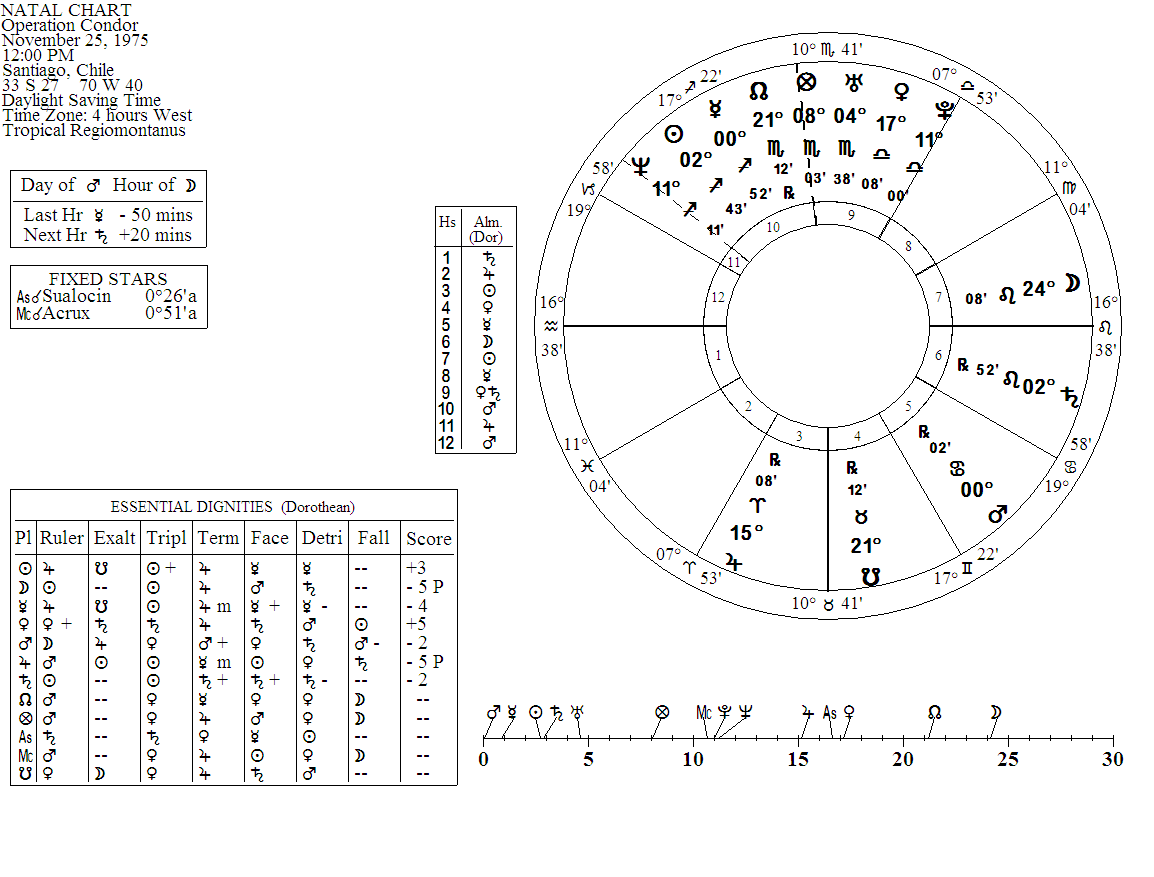
So on to our second question: what does terrorism look like? A recent article on the BBC on Operation Condor got me thinking about this. Operation Condor was a coordination of state-run terrorism by six autocratic regimes in South America during the 1970-1980 decades: Argentina, Brazil, Bolivia, Chile, Paraguay, and Uruguay. The purpose was to destroy any leftist opposition. According to documents discovered in Paraguay, the first meeting was set up in Chile on 25 November 1975 - the 60th birthday of reigning General Augusto Pinochet.

I have chosen to use a noon chart, since the time is unknown, and this follows convention for business and other such mundane entities. So what would terrorism look like? Classically, we would have to look to the three malefics: Mars, Saturn and the South Node. Here, we see the Moon in Leo at the Bendings, and specifically, the South Bending. In Classical Astrology for Modern Living, Chapter 10. The South Bending specifically seems to refer to scape-goating, which is probably an excellent description for the psychology of the dictators who felt such an obsessive need to eliminate anyone who could conceivably oppose their regimes. I find the specific placement in Leo to be incredibly telling: the sign of the king, a sign in which the Moon herself has no dignity at all, thereby showing all the emotional needs, without the strength to back it up. As for Saturn, it's in Detriment, the sign opposite its rulership. A planet in Detriment often manifests the qualities diametrically opposed to what it naturally does. Here, Saturn experiences the ego of the Sun. The Sun itself, the Light of Day is in Sagittarius, where it has Triplicity, and in a partile trine to the Saturn. Saturn is the use of authority in its most rigid and hierarchical fashion: here applied through the lens of personal ego.

Mars, of course, is the planet of violence, here placed in the first degree of its sign of Fall, showing again the idea of Mars energy turned around.So here, all three classical malefics are showing problems. Malefics behaving badly desperately need a positive outlet for the energy, like sprts. Otherwise, left to its own devices, the results can be very tragic.


Reference

Lehman, J. Lee. Classical Astrology for Modern Living : From Ptolemy to Psychology ∧ Back Again. Atglen, Pa.: Schiffer Press, 1996.

Tuesday, November 20, 2012

The KitchenAid Mixer and Pluto in Capricorn

Copyright 2012 J. Lee Lehman

Much of the text of Astrology of Sustainability is devoted to understanding from a mundane perspective how Pluto's passage through the signs really works. My historical analysis demonstrated that there is a lag phenomenon, a period of years in which the majority of people attempt to operate under the rules of the old Pluto sign. This period that can easily last years in the case of Pluto: probably as long as a quarter of the cycle, or more. When I was writing that book, Pluto was earlier in Capricorn than it is now. One thing I did say was that the transition of Sagittarius to Capricorn is about the most wrenching of the sign transitions, because the transition goes from Jupiter-ruled to Saturn-ruled, and people vastly prefer the openness of Jupiter to the rules of Saturn.

Here, having just witnessed Obama's reelection under the shadow of Pluto in Capricorn, there are some thing that are worth reflecting upon.In Obama's campaign in 2008, the watchword was change. This made complete sense, given Pluto's recent ingress into Capricorn. In Chapter 1 of Sustainability, I give the historical precedence for why we should take the first pass of a planet into a sign as the beginning of that sign period, even if it later retrogrades into the prior sign, Pluto went into Capricorn for the first time on 26 January 2008. Just how likely is Pluto to change signs during an election period? The last time this occurred was 1956, and the prior time was 1912. The next time will be 2066. So this has only happened twice before. So what was special about those elections? Woodrow Wilson won the 1912 election as a result of the Republican Party splintering between President Taft, and former President Theodore Roosevelt: in that era, the only time the Democrats could win the presidency was when the Republicans were too factionalized to agree on a single candidate. Despite the great disadvantage for national office of the Democrats at that time, Wilson won reelection, becoming one of the roughly 2/3 of presidents who ran for reelection who won. The other case was Dwight Eisenhower, an extremely popular president, running for reelection, who easily won a second term. So our very small sample size of two cases shows that when the Pluto sign change comes at an election with no incumbent, the other party not only has a good chance of winning, but of staying in office for the next term as well. The sign change in Wilson's case was from barren Gemini to fertile Cancer, from Mercury-ruled to Moon-ruled. This is a change, but it's not so dramatic as Jupiter to Saturn. In Eisenhower's case, it was Leo to Virgo, Sun-ruled to Mercury-ruled. Again, this is hardly wrenching.

What has struck me, now living through this process, is that over a quarter of the way into Pluto in Capricorn, I am still observing lots of phenomena that I would classify as leftover Pluto in Sagittarius thinking. Many of them have to do with the economy or economically-based decisions, whether personally, corporately, or governmentally. Let me explain.
  • First, astrologically, recession or depression looks a lot more Saturnian, and bubbles look like Jupiter. Thus, the housing bubble, derivatives generally, and running on credit, all look like Jupiter. The trend toward getting away from credit cards and using cash is Saturnian: living within one's means. 
  • Inflation looks more like Jupiter, and deflation looks more like Saturn. The credit crunch looks like Saturn. And yet, many banks and governments are acting as if inflation is what we must worry about.
  • Products designed for flash and features look like Jupiter, while products designed for durability look like Saturn.
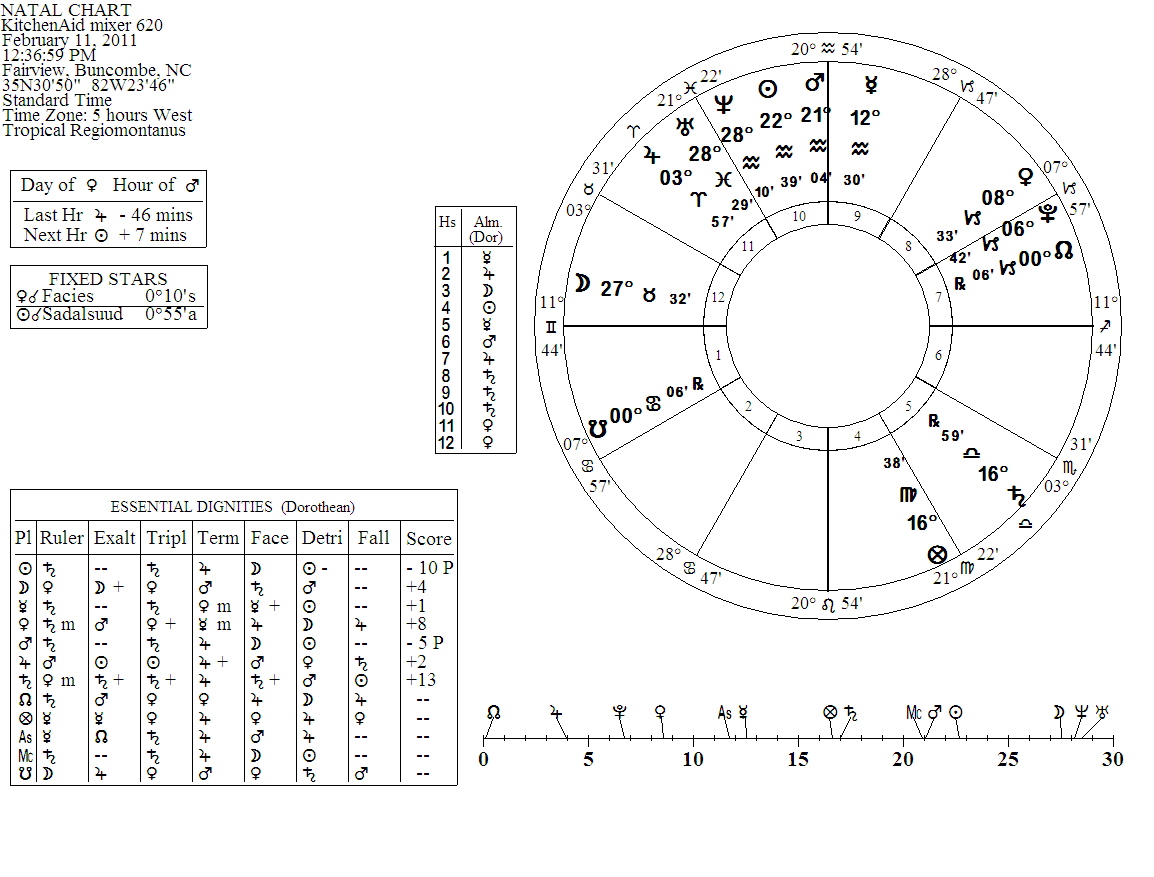
Which brings me to the KitchenAid mixer. Back in 2011, my partner Maggie bought a KitchenAid mixer. Not that she wanted to: her previous mixer had a burned-out motor. However, she got an incredible deal on it, and so she bought it. We did not elect a time.

How do you interpret the chart? First, the time was easy: we took it from the e-mail confirmation that she received from Chef's Catalog. We did not examine the chart at the time. However, looking at it now, the 1st house represents the subject of the event, namely the mixer, and we see the South Node there: not a good sign. The Moon was in Taurus, which we had probably noted at the time in a vague sort of way.However, this chart hangs upon Mars.

Why Mars? Mars is the motor! In a mixer, it dies when the motor gives out, because most of the other components are replaceable. Go onto EBay, and you'll find just about every attachment available. Similarly, you can get many parts from the manufacturer.Here, Mars was peregrine and combust. There was some debate in the Medieval period about whether Mars combust was an accidental debility at all: here the suggestion might be that it may not be as bad as another planet combust, but it certainly doesn't help! That poor Mars is the most elevated planet, and it's a Mars hour, torquing up the importance of Mars. But this is a weak Mars.

So a couple of weeks ago, Maggie went to make bread, turned on the mixer, and the sound was like a car battery dying. One dead motor. The value of the Moon in Taurus was that Chef's Catalog replaced the mixer with only the difficulty of the confusion of the Mercury retrograde period, in which they got it confused about whether she wanted a refund or replacement.

So now, we come back to Pluto in Capricorn. When she got the mixer, even though the model number was the same, it felt different to her. One of the blades she had bought wouldn't fit. I felt the included blades: and they felt lighter weight. In fact, when she bought the mixer, she had bought an extra bowl, and when we weighed the old bowl and the new bowl, the difference was over two ounces lighter for the new bowl.

As we have been seeing for some time, corporations are finding all the ways they can cut manufacturing costs to maximize their profits. Everything about this new mixer is cheaper - and yet its price in the Chefs Catalog has risen about $100 in the less than two years since Maggie bought it, in the midst of this very inflationary period! This is Pluto in Sagittarius thinking on the part of KitchenAid: build cheaper equipment which dies sooner, but has nifty features, thereby hopefully encouraging the customer to buy the latest and greatest because of its still sexier features.

How long before corporations "get" it? Also in Astrology of Sustainability, I discuss the agency of outer planet cycles for change - specifically, that we are in a period until 2020 with no major outer planet conjunctions. Evidently, we are all likely to be slow learners for a while.


Thursday, November 15, 2012

Gaming Models and Presidential Elections

Copyright 2012 J. Lee Lehman, PhD

For many years, I have been interested in mundane methods for predicting the outcome of sporting events. Originally, I worked primarily with William Ramsey's rules. Later, I also worked with Bonatti's rules of warfare. In the latter case, I developed methods for working with presidential elections based on quantitative models: assigning points to each of the criteria used. I believe that this work is vital, because only quantitative models avoid the judgment calls that make historical work truly useful, rather than speculative.

The pitfalls of non-quantitative models was illustrated all too well in Sylvia De Long's 1981 work, Charting Presidential Elections. In this book, she presented a model using Saturn to rule the Democrats, and Jupiter to rule the Republicans. She used elevation and disposition as two of the factors to judge which planet was stronger in the chart for sunrise on Election Day.

The problem? The one advance chart she gave was 1984, in which she predicted that the Democrats would win, instead of 1984 becoming the reelection of Ronald Reagan. Oops. Now - we all will be wrong sooner or later in our predictions. But the point, I think, is that, when you know what the outcome was, it is difficult to be truly objective in rating the charts. Unless you have a friend run the data, then chop the chart information off the print-outs, it's hard to actually retrospectively predict rather than explain.

I made my own predictions for 2012 in August at a talk I delivered to the Northern Illinois Chapter of NCGR. I wanted to share a couple of my slides, to illustrate some ideas about mundane prediction, especially using gaming models.

I would also like to note that the media has given little coverage to the fact that not only were there several of the media statisticians like Nate Silver exceptionally accurate - but so were the betting models. Jamie Partridge has also mentioned this. During the run-up to the election, sites like http://www.predictwise.com/ and http://www.betfair.com/ were showing Obama winning consistently. Predictwise was likewise very accurate on the results for the US Senate.

So: about the astrology. I presented two different discussions: a comparison of natal charts based on chart comparisons from prior elections where we had good birthdata for each candidate.

For example, comparing the last three outer planet transits before the election gave these results:


This wasn't a stunning call for Obama, but given that Saturn aspects seemed more likely in winners, the fact that his last three aspects were all Saturn did argue for Obama. When I counted up which transiting planet aspected the natal chart, I did not break the data out by transited planet: off-hand, Saturn square Saturn seems harder than most.

Another example was the lunation cycle. I saw a number of predictions based on Romney going into the 8th phase as a negative.


This was a technique that was not predictive in this race, although I saw it used by several astrologers as an argument for Obama. Here;s the issue. This graph shows the actual historical count. Romney was born in the 6th phase, which, according to the graph, has more winners than losers. He had just gone into the 8th phase in September 2012. Given the description of the 8th phase in Rudhyar's work, this makes absolute sense as a call for Romney to lose. In the actual data going into this election, there was only a small elevation of losing associated with this phase.

Contrast this with Obama. Obama's birth phase, the 7th, is not historically good for presidential winners, whereas Romney's birth phase was. Obama's phase at the 2012 election had heretofore only been occupied by losers.

We don't have a lot of data points to work with here, so these results so far are just a start.

We have more data for mundane models, and this is what I will review now. My model is based on the following:


The major question is: what charts work? This is my summary slide of results leading up through 2008.


It was typical in the classical period to examine all outer planet conjunctions. Since the Outer Planets hadn't been discovered yet, that meant the Mars-Saturn and Mars-Jupiter conjunctions, as well as the more famous and more powerful Jupiter-Saturn. Here, the Mars-Jupiter and Mars-Saturn would potentially be interesting, because there is always at least one such conjunction between each election. Thus, one cycle of Mars and Jupiter or Saturn can only apply to one presidential cycle.

This being said, that doesn't guarantee that either of these cycles is predictive. In fact, the Mars-Jupiter does not appear to be. Similarly, the prior solar eclipse and the Inauguration Day chart are not predictive, at least using this particular rules of war model. This does not mean that some other model could not use these charts.

We may further note that the Libra Ingress turns out to be one of the more predictive charts: but in reverse. This is what is called a contrarian model: you take the winner as whatever the model deems the loser.

Examining all these charts together gives the following prediction, based on the historical model:


Going back to 1912, this combined model has been wrong only three times: in 1932, 1952, and 2008. It is interesting that 1932 was the first election after the onset of the Great Depression, and 2008 the beginning of the Great Recession: major economic downturns which clearly were outside the bounds of the model.

My future concern - that Election Day charts may become obsolete as more of the country moves toward early voting - may in fact be borne out by this year's data. The last time both Election Day charts were wrong was 1972: and these two charts have only both been wrong twice in the last century. We shall have to watch this trend.

References

Bonatti, Guido. The Book of Astronomy by Guido Bonatti. Trans. Benjamin N. Dykes. Golden Valley, MN: Cazimi Press, 2007.

Brady, Bernadette and J. Lee Lehman. Twelfth century castle besiegement in sport. The Astrological Journal 39(3): 27-44, 1998.

DeLong, Sylvia. Charting Presidential Elections. Tempe, AZ: American Federation of Astrologers, 1982.

Ramesey, William. Astrologia Restaurata, or, Astrologie Restored Being an Introduction to the General and Chief Part of the Language of the Stars : In 4 Books ... : With a Table of the Most Material Things Therein Contained. London: Printed for Robert, 1654.


Sunday, November 11, 2012

The Indianapolis Explosion

Copyright 2012 J. Lee Lehman, PhD

It is odd waking up to the news f an explosion which takes out a house in a normally quiet city. We expect these things in war zones, and so all the descriptions of the scene picked up that image. From an astrological standpoint, the first thing that we want to know is what caused it. In this case, the chart gives a pretty good indication that the initial theory of a gas explosion is probably correct.

Data given bu USA Today, 11 November 2012.

First we see the Leo rising 0 fire. That is what all the preliminary pictures focus on: the appearance of the neighborhood as if a fireball had hit. The ruler of the chart is in the 4th, with dignity only by Face: the dignity that I have referred to as having the keywords fear and anxiety.

The presence of Neptune at the 8th house cusp does look like the gas leak scenario. Jupiter, ruler of the 8th house cusp, is not only in an air sign (gas!), but doubly debilitated: by being in Detriment, and being retrograde. That leaves little of its more benefic qualities, and more of the inappropriate expansive ones.

Saturn is at the IC. Were this a horary question about buying a house, that Saturn would immediately make me think there was something structurally wrong there.


Wednesday, November 07, 2012

What has the 2012 Election Taught Us?

©2012 J. Lee Lehman

First, congratulations to all my friends and colleagues who dared to predict the presidential election. I congratulate everybody, because the first step is to try.

I also hesitate to congratulate only those who predicted correctly because this kind of prediction is difficult, and fraught with problems. It is in the spirit of humbleness that I would like to address some of the problems I see in this prediction process, as well as to herald some things that I think we as a community are beginning to get right.

In the category of right, I congratulate the Political Astrology Blog and Chris Brennan and Patrick Watson for their work through the last two elections in providing a resource for predictions made, and timings recorded. It is extremely useful that the information from one election is not just quietly disappearing before the next cycle: and the next. We can only learn from developing a historical database. It is also for this reason that I urge everyone who has posted predictions or discussions of this election to not take them down. I know that nobody really wants to keep remembering their mistakes, but there is still gold to be mined in understanding both the "correct" and "incorrect" analyses - because hardly anybody gave single reason predictions. I would claim some small credit for Kepler College in helping to initiate a more serious discussion of these matters.

Here are some ideas I would throw out as important.

There are two psychological factors that we have to keep in mind that have major bearing, not only on our predictions, but those of the media, and citizens at large, whether of the country in question, or not.

  • It is an extremely well documented observation that virtually everybody makes the mistake of believing that other people agree with them more than is actually true. I have observed and commented for some time that there has historically been a high correlation between who astrologers predict will win with whom that astrologer will or would vote for. If we understand this within the context of this psychological tendency, we understand the very real peril: that if we believe that the universe is ordered, and we are right, then of course the universe will work out according to our own beliefs. While not a fully conscious process, this represents a considerable danger in making predictions.
  • When, as today, we are engaging in the post-election discussion, the tendency when one is wrong is to find a factor in the charts that one examined that could be construed as going in the opposite way, pounce on that factor, and then explain one's wrong prediction as being a result of that. So far, this may be plausible. But the real error is then the all too human tendency to believe that, having found the magic bullet, that one's prediction is transformed into a correct prediction, for having been explained.
In fact, predicting the outcome of political elections means using astrology in a fundamentally different way than we normally do. Natal astrologers are simply not generally called upon to compare two charts and see which one would be victorious in a contest held upon a particular day.

This simple reality is further complicated by the fact that everybody had a roughly 50-50 chance of being right or wrong. Thus, we are confronted with the probability that some of the correct predictions for Obama were actually fundamentally flawed in analysis and right by chance, whereas some of the predictions for Romney were just slightly incomplete, but primarily correct. How does one tell the difference, especially since we only repeat this exercise at four year intervals?

For now, let me address some particular factors, in the hope that they can help the thinking process for future elections.
  • The prediction of two-party models is completely different than parliamentary models, because only two party elections resemble the warfare models of which I am fond. If there are multiple armies on a battlefield, each one is not fighting all others: they are already aligned as allies, which is not how multi-party systems work.
  • I think we have to come to agreement for the future that if the US system is that the actual victory occurs through the Electoral College, that winning the Electoral College is the measure of a correct prediction. Frankly, we don't have enough data for a model of when an election is split between popular and Electoral College. However, I have to admit that I am being dragged kicking and screaming into developing some respect for the Electoral College idea. Had a hurricane or earthquake actually occurred on the day of the election, thereby significantly lowering a populous state's voting; or had a state referendum significantly changed the voter turn-out in just that one state; then the popular vote might not actually be more "just" than the Electoral College.
  • This election was the first failed case since Al Morrison pointed out the theory: that people nominated under a void of course Moon do not win the election. Obama was, and he did. My comment on this is twofold: first, there are no single factor arguments that I know that will work absolutely all the time. The second point is that the void of course has, imho, been blown up way out of proportion. It is merely one of the ways that the Moon can be afflicted. We must study them all.
  • This leads into the next issue: is there any critical event prior to the election itself that determines the outcome of the election? We don't often discuss this matter of multiple events surrounding an event, but we have the time a person announced candidacy, the time the election campaign is established, each of the primaries, the date of the primary at which the candidate receives the votes needed to become the candidate, the time that this is declared by the media, the time the nominating convention begins, the time that the candidate is announced as winning the nomination, and probably several other dates I am forgetting. Are any of these fail-safe predictors of the results? I tend to view these matters in the spirit of electionals in a string of related issues like a relationship (where one can do charts for the time of meeting, the first date, the first sex, moving in together, marriage, etc.): the most important thing may be defensive charting: that none of these event can predict a success, but any of them could preclude one.
  • Horary: it's time to give it up. Sorry, but let's stop kidding ourselves. In a world of seven billion people, the idea that any one of us citizens has the special pipeline to the truth about this is delusional. This cannot work, because of two irreconcilable problems: that we cannot know when the question was asked for the first time (making all subsequent attempts bogus with random access results), and we aren't really any more special than any other citizen of the Earth. I was especially disheartened by reading an argument that perhaps one gets the right answer if one has greater virtue. No comment. But I think the fact that there are many astrologers (me among them) who adore horary doesn't make this an appropriate technique.
  • It may do well for Americans to study European parliamentary elections as a model for the primary season. We simply don't have a model for what to do with multiple candidates.
  • In a world of early voting, it's time to revise our models. Dixville Notch is now a lovely historical asterisk, when literally millions have voted before those intrepid few have stayed up for their election night party. We may see a decline of importance of election day charts as being predictive, because so much of the voting has already occurred.
I believe that successful work on elections will occur through the combination of mundane techniques, and natal work focused around learning the appropriate factors to compare between timed charts of candidates: a database which now stands at seventeen cases where we have good data for both candidates. This is slow, hard work.

But most of all, I encourage my colleagues to persevere, always using caution about applying hindsight instead of foresight.

Saturday, October 27, 2012

Think like a Classical Astrologer!

Copyright 2012 J. Lee Lehman

It happens all the time. Every time an astrologer interprets a chart, a creative process must occur, linking astrological symbolism to the person, question, or event under study and interpretation. However, the context in which this creation occurs can be very different from astrologer to astrologer.

As more astrologers have begun to explore classical (also called traditional) astrology, it is sometimes not entirely clear how it is necessary to change one's thought processes. Here, I want to give just a brief explanation of how this works.

Many students of astrology have experienced what we might call the "blank slate" state - you've studied all those various books, but upon encountering a new chart, you freeze: now, what do I do? This in fact is one of the major dividing lines in astrological education: between the people who have broken through this barrier and those who have not. Until you do, the only recourse is to attempt to use cookbooks to provide enough of a story to fill in the words that somehow don't otherwise trip easily off the tongue.

But how that barrier is breached is incredibly important, because it reveals the type of astrology that can then come forth.
  • If one approaches astrology through myth, then the way to move through to interpretation is to carefully consider the Native's situation, and to find the myths that apply the story for the person's situation. Then it remains to tell the story, and to adapt it to the conditions at hand.
  • If one wants a psychological approach, one listens carefully to the client to understand the psychological matrix of the client's circumstances,  and from these, one uses the astrological symbols to guide the psychological process and exploration.
  • If one takes a classical approach, then the first stage of the delineation is to ascertain the historical precedents for the situation, so that one has a guide to the means of interpreting the astrology of the moment, and what it portends.
In a sense, these three methods share an approach: the first stage of the process is obtaining the general map of the terrain, so that the interpretive process may begin. It's useless to look for Chicago, Illinois on a map of Europe. The first stage of the process always sets the general parameters for the search for appropriate knowledge, tools, and information.

To give an example, what rules writing and publishing?

Modern astrology is an overarching term for the astrological methodology that has developed since the 17th century, and primarily in the 20th century and beyond. Lacking one cohesive lineage, the modern practitioner has no one simple path to answer this question. The astrologer may appeal to an authority, such as a published book of rulerships, or to a listing of items rules in a cookbook. Or as likely, the astrologer may simple try to "logic" the answer. But how does one do that? Often, one tries to come up with an analogous item: so one can think about writing involving words, solitary activity, but publishing brings it out into the world, etc. In this way of thinking, there may be no right or wrong answer, but if this question has come up because of a horary, the result of this process may produce a right or a wrong prediction.

In classical, the process is different. The first step is: what has anybody said about this in the past? It was to facilitate these questions that I originally published The Book of Rulerships, which lists what a number of previous classical authors have said. While this work, being some twenty years old, did not encompass the many works of classical astrology which have been translated since, it is a good starting place. I have also published a supplement to it on my website. Here, we discover the following:


Rulers
Item Ruler Reference
Writers 12 AB-276
Writings ME LI-139
Writings ME D2-025
Writings GE KB-016

For example, al-Biruni (the abbreviation AB) said that writers are ruled by the 12th house. Perhaps this refers to the solitary activity of writing. That number after the abbreviation gives the page number in the cited reference. So Lilly (LI) says that writings are ruled by Mercury on page 139 of Christian Astrology. Kirby and Bishop (Bishop, John, and Richard Kirby. The Marrow of Astrology the Second Part. Wherein Is Contained, a Table of Houses, Calculated for the Latitude of London: With Tables of Semidiurnal and Seminocturnal Arches. Also Tables of Twilight and Mundane Aspects; and the Whole Doctrine of Nativities, Laid Down in Twenty Genitures, According to the True Intent and Meaning of Ptolomy, Wherein Is Discovered the Errors of Argol, Regiomontanus, and Others. The Like Never before Done in English. By John Bishop, Student in Astrology and Chimistry. microform. printed for Joseph Streater near Paul's-Wharf in Thames-street and are to be sold by the booksellers in London, London, 1687.) give Mercury as ruling writing.

Once one has these classical precedents in hand, then one has to decide which of them to use, or if a rethink of the concept is necessary in light of modern technological or societal changes.

In fact, the issue of rethink is always present in astrology, whether ancient or modern. Consider gay marriage! It simply didn't exist as a possibility when any of these sources were written, including the 20th century rulership references!

The primary difference in thinking classically is knowing to start with what astrologers have known in the past. This gives a firmer grounding to making any decision about adapting the precedents, instead of simply using them. This may require extra works, and a couple extra steps, but laziness is no excuse for sloppiness.


Saturday, August 11, 2012

The 5th House in the Current Stock Market

Copyright 2012 J. Lee Lehman, Ph.D.

For years in my personal practice, as well as in Martial Art of Horary Astrology, I have followed the standard pattern of referring to the stock market as a 5th house matter: gambling, in other words.The idea was: when you invest in the market, you are engaging in a practice similar to traditional gambling: you may have a model you are working with, or technical factors, but your "bet" still involved the Wheel of Fortune: Lady Luck. Thus, astrological practice would make this unequivocally a 5th house matter.

I want to call attention to the fact that this may not longer be true. The reason is simple: computer trading. A recent article in the BBC pointed out just how much computer trading is going on. The basic idea is this: there is now a huge amount of computer trading going on, where programs are actively looking for anomalies in market price, and trading accordingly. Computers can do this on a scale vastly beyond the capability of a human being, or even a conventional brokerage house. A computer program that has access to market data in real-time can perform so many calculations per second that there need not be much "intelligence" there - just a lot of horsepower to perform crude but numerically overwhelming crunching, which then itself becomes a trading strategy, because it is the computers initiating the trades. I would then ask: apart from when the programs glitch, how much randomness or luck is left in the market?

Given this question, is stock trading any more a 5th house activity? I am personally reexamining this issue in terms of my own portfolio, but I am also going to begin to take this into account in my astrological advice.

In fact, I have noticed a definite shift in electional work that has been building steam over the last decade or more. The basic question is: when the other "party" is a computer, do the traditional astrological rules apply?

Saturday, April 16, 2011

Is Horary Really Technical?

Call this an "open answer" instead of an "open question." There are many ideas that natal astrologers hold about horary that are frankly just plain strange. They are also largely artifacts of ignorance, which is not necessarily the fault of the person holding the opinion, but may well be the fault of their teachers, and of many of the people who have authored books on natal astrology.


Today, I received an e-mail from a person who was simultaneously intrigued and nervous about studying horary, because she was afraid it is too technical for her to grasp. Here is my response.


I don't see horary as any more technical than a host of things I have studied. What I would say is that horary is actually very procedural. All that means is that you call a spade a spade.

In natal, does saying that Leo is a fire sign mean natal is technical? Because, within the classical period, natal astrology was every bit as "technical" as horary.

So I guess I'm not sure what you mean by "technical." Does it run by rules? Yes! But what about that makes it problematic?

Imho, the following statements are true:

1. Most astrology books and astrology courses are written by well meaning people who don't know how to either write or teach. This is not a reflection of their moral or intellectual worth, but simply a statement that you can hardly expect people to intuitively know how to do either skill well. The same thing happens in martial arts, when people study for a while, and then are thrown in as teachers, without teaching them how to teach. The results are rarely satisfactory for either party.

2. Part of the evidence for 1 is that the knowledge conveyed is inadequate when it cannot be applied outside the examples given in the book/class. Many authors make statements that are so vague that they either apply to every chart, or no chart, and the poor student is left to wonder what they misunderstood. It is always easier to believe that you cannot understand the author - which is your fault! - than that the author got it wrong.

3. The real problem in writing and teaching is that most authors and teachers are not actually thinking about how to engage in astrological reasoning, and instead are attempting to teach only by applying their own knowledge as if it were drawn out of a barrel randomly rather than systematically applied.

4. If you don't teach systematically, nobody learns anything, except by attempting to reverse engineer.

5. Good teaching requires a defined curriculum, where the student is clear about what the purpose of the instruction is, what is expected of her or him, and what constitutes closure, at least in that particular course. Classes which continue indefinitely have a habit of becoming either entertainment or dependencies, rather than learning.

So, to my question to you: what is wrong with "technical," that this should be an impediment to learning?

Do you have problems following an instruction like, "Raise your right hand?" Because that is technical.

Do have have a problem with logical reasoning, like, "If the Moon is in the 8th house, then the Querent may be thinking about death?" Because reasoning is technical.

Are you concerned that you could never learn all the "rules?" No problem. Nobody does. As with law, the important thing is not memorizing, but knowing where to look them up.

Do you have a problem because you don't know why that statement about the 8th house might be true? In that case, I'm afraid no astrology will ultimately be satisfying for you, because while it may be possible to historically date the statement, no astrology brings you to the primary cause or complete truth about anything.

Is the comment about technical really a statement that you are afraid to put your astrological knowledge and reasoning to the test of a crucible in which you have to declare a judgment than can be then declared to be either right or wrong? In that case, then how much faith do you really have in what you have learned?


Beyond this particular person's concerns, the other great dig at horary is that it legislates against free will. It doesn't. Fate is merely the statement of what happens when you have neither the time, the will, nor the inclination to exercise free will. And that's the problem. The exercise of free will takes energy, will, and time, commodities that are often in short supply. And of all of them, the exercise of the will, or intention, is probably the commodity in the shortest supply. People are not encouraged to really think carefully about their options and make a considered choice between options that have been seriously studied. We are encouraged to pick between the red or the blue on impulse, not think about whether we really wanted that new car, or whether it is a good choice based on environmental considerations.

The expression of free will is difficult, because we have to think, we have to question, and we have to discover a path that nobody tells you to take, and nobody gives you very many points for choosing. I am completely in favor of free will, just as I know it is in short supply.


Horary "works" because it is the measure of how things will unfold in the absence of free will. Thus, horary is not an opinion about free will, but about how people operate when they themselves have abrogated free will.

Monday, January 10, 2011

The Arizona Shooting

©2011 J. Lee Lehman

Before anything, I have to express my personal dismay that we even have such astrological moments to interpret. Shooting politicians is not a mark of a civilized society, no matter what the Hatriots, who have furthered their careers and pocketbooks, may think. Rhetoric kills.

I have to admit to a personal connection: my parents had retired to Green Valley, AZ, a town just south of Tucson. Accordingly, I have visited Tucson numerous times. My parents had bought from Giffords' family business. I know the addresses given. Giffords was elected the year after my father died, but I have no doubt he would have voted for her.

It took a while to sort out the chaos surrounding the shooting of Congresswoman Gabrielle Giffords two days ago. The time has been given from 10:00 - 10:11 am, but the difference is not that meaningful in examining the chart. Can it tell us anything useful about the event, and what will come of it?

At 10:00 am, Saturn is much closer to the 8th house; at 10:00, the Moon is much closer to the Ascendant, but with either chart, these are the two great symbols we see. When I first read the reports, and learned of the death of Judge John Roll, I wondered whether in fact he was the target. We have since learned otherwise.

Chart for the shooting of 20 people.
How should we view the chart astrologically? I would propose that one very good way to do this is as a decumbiture. There are two major unknowns at this point: the prospect for Giffords' recovery, and the disposition of her alleged attacker. Quite honestly, I am far more interested in the former than the latter.

If we do so, here's what we can see. From what we know at this point, Giffords was the target of the shooting, and, as the "subject" of the event, the 1st house. She was most certainly not the only victim of this event, but what we can all agree is that, had it not been for the murderer picking her as a target, all the other people would be alive today. Those other victims, I suspect, are shown by Saturn, so close to the 8th house cusp.

The Moon is right at the Ascendant. (Remember, the time uncertainly means that the Moon could have still been in the 1st house, but conjunct the Ascendant nonetheless.) The Moon rising in electional astrology represents change - and this certainly represents a change in her status! The partile conjunction of Jupiter-Uranus, with the Ascendant being ruled by Jupiter spells out the suddenness of the event.

The good news is: the Moon and Jupiter (as ruler of the 1st) are not in approaching aspect to Venus, ruler of the 8th. This would be the primary argument for her death: if the Ascendant ruler of the Moon was approaching an aspect to the ruler of the 8th. In fact, the Moon was separating from the square to Venus.

The next consideration is the degree of her recovery. I think she will make a good one. Jupiter is dignified in Pisces and, given the relatively late degree, it is also dignified in Aries. With the Moon separating from, rather than applying to, Neptune, I believe her medical team is able to read her condition well. The 6th house, her "disease," is ruled by the Sun, which is peregrine. When the ruler of the 1st is stronger than the ruler of the 6th, it means that the patiet's vitality is stronger than the disease. This is alo encouraging.

Jupiter also rules the 10th house of treatment, which is a good thing for her. There will be some bumps along the way, but this would take a thorough analysis of the critical days to examine this question further. But with the Ascendant in a mutable sign - those which used to be called common - I should think that her recovery won't be as fast as we would hope, but with the dignity of her ruler, I think we will be heartened in the end.