Thursday, February 07, 2013

Is the Astrology World ready for Linux?

©2013 J. Lee Lehman

Linux?

Back when I was relatively new in the computer consulting world, many of my installations were in Unix. Unix is a stately old operating system with a solid university backing to its lineage that was designed for a multi-user environment. In fact, back then, people didn't have pc's on their desks: they had dumb terminals. A Unix design allowed even a relatively small business to have the luxury of a true multi-user environment, where different employees shared data between inventory, order processing, billing, payroll, and accounts receivable. Most desks had an IBM Selectric typewriter on one side, and a terminal on the main desk.

Unix was fun for me, and I loved coding database designs. But that was then. After I had been doing that for maybe ten years, the Windows operating system arrived, and the typewriters were on the way out. Networking became the name of the game, and I lost interest, because I didn't like the new databases for pc's. And a good thing, because my astrology business had grown to the point where I had to choose one.

But all these years later, I still reserve a soft spot in my heart for the simplicity of Unix that Windows obscured. All those jokes about Microsoft: like the one about if the Windows operating system ran our cars, they would stop randomly in the middle of the road - and nobody would complain. But still, I stuck with Microsoft for the simple reason that all the astrology programs of any complexity were native to Windows. Sigh.

Then along came Linux. I hadn't really kept up enough to follow its trajectory at first. Call it inertia: I had all these other things to think about, like which Triplicity table to use, and which way to calculate the Ruler of the Nativity. But every release of Windows, I groaned. It became clear to me that the operating system new editions, like much of the established software upgrades, were artificial cycles designed to keep the corporation's balance sheets humming, not mine.

About four years ago, after some encouraging words from my brother, I decided to get my feet wet in SUSE Linux. Mistake. No matter how much I had been hearing about open standards, the installation packaging left so much to be desired that I quit after about a week of frustration. But I still remembered the hype: Linux is fast, Linux is free, Linux is open source. Sigh.

Several months ago, my partner Maggie Meister reminded me about Linux again. At first, I groaned. I don't have time for any big learning curve! But then I made contact with a gentleman who is writing a new software program for classical astrology using Xbuntu, and so my curiosity was peaked.

I started reading on Ubuntu, which is a flavor of Linux. (Xbuntu is Ubuntu with a different desktop; in the Linux world, such fracturing is possible and yet everybody stays friends.)

Unlike many open source scenarios, Ubuntu has some serious money behind it, because Mark Shuttleworth, after making mega$ online, put some of that money back into developing a flavor of Linux that would work for the rest of us. This has translated to regular operating system upgrades, the writing of all the background stuff like hardware drivers, and not least, the development and implementation of the vision for a Linux for all of us.

So I was psyched, but I also remembered my disaster with SUSE. I had discovered that both Dell and Toshiba have made their product lines Linux compliant, and that many other hardware companies have done the same, at least with some of their models. So after much thought, I decided to buy my hardware from a Linux specialist: the machine would come with Linux already installed, and so I wouldn't have to sweat over things like getting the wifi up and running, which was one of the things that had utterly defeated me on SUSE.

In less than a week, my machine arrived, and then I only had to wait for the time I elected that evening to start it up! Right away, I was online, running Firefox (my preferred browser for years), running Libra Office (a sister to Open Office that is completely open source; Open Office had been my go-to for years), and going through the check-list of programs that I had created to map out which programs were cross-platform available, and how I would proceed with the conversion. Skype, Dropbox, Audacity, and Evernotes were some of the applications that were already available in Linux editions - although Evernotes is actually a Linux special work-around called Everpad.

My first goal was to eliminate the Windows 7 computer on my desk, and I accomplished that within two days. I am composing this on the Ubuntu machine with an XP netbook to my left, in the alternate computer place. A week later, I still have not turned off the XP. However, I probably will within the month.

This blog entry is to detail how I got there, what you need to know, and whether it's worth it.

First: I am very happy on Linux. It is for real much faster than Windows. The Ubuntu interface is enough like a cross between Windows and Mac to have a familiarity about running it that allows the user to get pretty far without having to look things up. I did purchase The Official Ubuntu Book (7th Edition), and I have been working my way through it - and it has been very helpful.

One of the first things I fell in love with was the four desktops. Yep. I've generally tended to have a whole bunch of programs running: e-mail, Firefox, accounting, Sirius, Solar Fire, Solar Spark, possibly one or more other astrology programs, not to mention word processing, possibly a database or spreadsheet,a presentation program, and maybe a audio or video program. What a mess! Now my projects are split out between four regions which are switchable through Ubuntu-S (yes, being an Ubuntu machine, I don't have a Windows key, but an Ubuntu one). So now, astrology is on one desktop, the Internet on another, my sound editor and presentation program on the third....

But: is this ready for astrology prime time for someone without a Unix pedigree? My answer is: it depends. If your primary program is Sirius, Kepler, or Nova Chartwheels, the answer is: yes. If your primary program is Solar Fire, then the answer is: maybe. And what follows is why there is a difference.

Crossover

 A long time ago, Linux people realized that there were a lot of programs on Windows that Windows alums would quite justifiably want to maintain under Linux. And thus, wine was born. In Linux, wine is not a drink, but a platform to fool a Windows program into believing that it's really loaded on a Windows system. Wine creates a bottle in which it takes the Windows program's outputs and inputs and translates them into calls that Linux understands. The thing is, wine can be pretty tricky to implement.

Enter Crossover. Crossover is a program by Code Weavers that automates much of the wine process so well that if you have copied over a Windows .exe or other program file, or you put a Windows installation cd in your cd player, Crossover will very nicely ask if you would like it to try to install the program. I used Crossover to install Microsoft Office 2007, Sirius, AstroTides, my e-mail program (Thunderbird comes installed), and a whole host of utility programs. Crossover also runs on Mac's.

Here are some of those results.


 What you see above is Sirius, from Cosmic Patterns. You also see a desktop view with a couple of features. Ubuntu has something they call the Unity interface: you see on the left side a series of icons: these are the common programs and procedures. Unlike a Windows desktop, these icons are always in view to the far left.

The only problem I had loading Sirus through Crossover is that the Sirius installation is a two-cd operation, and that is currently flaky in Crossover: I solved this by installing in Windows, and then copying it over.

This also brought up an issue which is generally true in Crossover bottles: the issue of multiple windows within a program. When you ask for a new chart, Sirius pops up a data entry window. It's very easy for the entry window (which is smaller) to get "trapped" behind the main window.

In the background of the Sirius window, you will see a couple of file manager programs. Linux has file management similar to Windows (actually, of course, the Unix architecture predates Windows), but one of the commands in common is ALT-Tab for switching between programs: something I probably used every day of my Windows life. ALT-TAB has an extra feature in Linux: if you hold it down on a program icon, it will then allow you to switch between the open windows within a program - a very handy feature. If I was doing data entry in Sirius, then get interrupted by a phone call or e-mail and come back to the astrology desktop with the main Sirius screen up front, it will be locked because the data entry screen is actually controlling Sirius at that point. ALT-TAB allows me to see the problem, and get to where I need to go.


Next, we have Nova Chartwheels. I didn't observe any anomalies in bringing this up, but I also confess I am not a power user of this program. But notice: I had no font issues with either Sirius or Nova Chartwheels when I brought them up.


Astro Tides is a little utility program from Esoteric Technologies that apparently never took off, which is unfortunate, because now Esoteric Technologies is no longer supporting it, and it has some great features, like being able to scan time periods for the lunar mansion. Perhaps the fact that it runs flawlessly under Linux will yet breathe new life into it.

Virtualbox

If the program you want won't run in Linux, there is another option, but it's definitely Plan B. That option is VirtualBox, a program by Oracle. By using VirtualBox, you can actually create a ship-in-a-bottle on your Linux hard disk in which you can load an alternate operating system. There is only limited communication between them through some shared resources. If you want to load Windows, you actually have to buy a copy of the Windows operating system and install it within the VirtualBox environment established. This is how I got Solar Fire running.


Let me emphasize that getting VirtualBox going is not something to do if you have any fear of computers! It's tricky, but I got great tech support from both my hardware supplier and the company from which I bought the Windows operating system cd's. What you are seeing on the screen is the actual VirtualBox which contains Windows XP, and then the VirtualBox control screen behind it.


Finally, here's my old friend Solar Spark, another somewhat orphan program from Esoteric Technologies - mostly, I suspect, because getting these small programs compatible with Windows 7 and then Windows 8 was probably just not worth the expense.

 The other thing to be aware of is that setting up VirtualBox does put system performance at risk because we already know that Windows is a hog. I configured the VirtualBox to only use as little of my systems resources as I thought I could get away with. Certainly, it's a grand idea to pick one Windows operating system to implement, because while it is possible to run multiple operating system, each one chews up resources.

Happy hunting!


Saturday, December 22, 2012

What does Terror Look Like?

Copyright 2012 J. Lee Lehman, Ph.D.

As the horror of the Connecticut school shooting has sunk in, the raw emotionality of the event has triggered inflammatory language from people of different political spectra. One of the words that has popped up frequently is terror, as in terrorism. As a second-generation teacher, being a language cop is one of my attributes, so here I wish to consider two questions: can terror truly be the term for a single person acting alone without a political agenda, and, in any case, what does terrorism look like astrologically?

We are confronted with a linguistic issue: terror, we learn, is extreme fright, and certainly there was plenty of that going on at Sandy Hook Elementary School. A terrorist is someone who foments terror, and that could certainly be said for the murderer. The word terrorism prior to the last few decades applied to terror applied by a political entity, such as the Reign of Terror during the French Revolution. Now we apply terrorism to any group that attempts to organize terror as a political statement, whether that group is a state, a political party, or an ad-hoc group. We are left with the position that the mass murderer can probably rightly be called a terrorist, but what he did was not terrorism, it was disgusting mass murder.

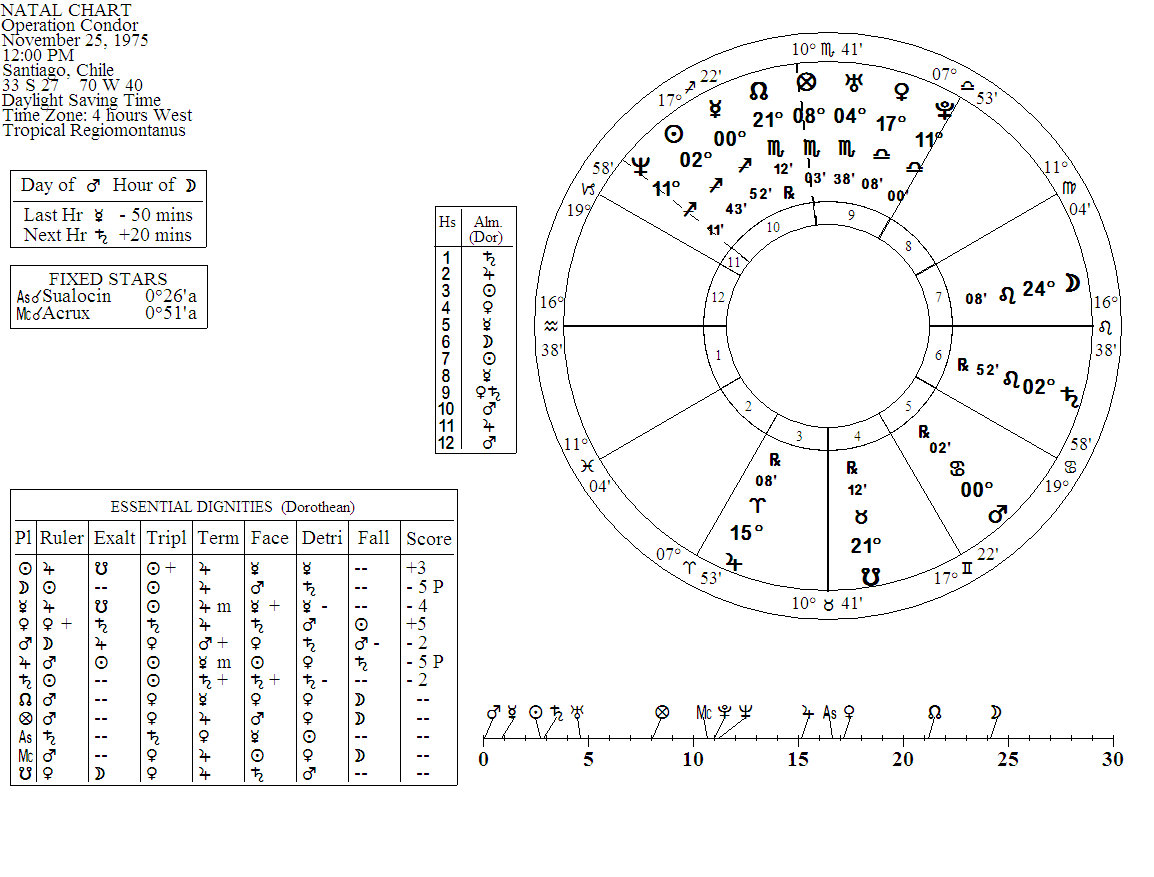
So on to our second question: what does terrorism look like? A recent article on the BBC on Operation Condor got me thinking about this. Operation Condor was a coordination of state-run terrorism by six autocratic regimes in South America during the 1970-1980 decades: Argentina, Brazil, Bolivia, Chile, Paraguay, and Uruguay. The purpose was to destroy any leftist opposition. According to documents discovered in Paraguay, the first meeting was set up in Chile on 25 November 1975 - the 60th birthday of reigning General Augusto Pinochet.

I have chosen to use a noon chart, since the time is unknown, and this follows convention for business and other such mundane entities. So what would terrorism look like? Classically, we would have to look to the three malefics: Mars, Saturn and the South Node. Here, we see the Moon in Leo at the Bendings, and specifically, the South Bending. In Classical Astrology for Modern Living, Chapter 10. The South Bending specifically seems to refer to scape-goating, which is probably an excellent description for the psychology of the dictators who felt such an obsessive need to eliminate anyone who could conceivably oppose their regimes. I find the specific placement in Leo to be incredibly telling: the sign of the king, a sign in which the Moon herself has no dignity at all, thereby showing all the emotional needs, without the strength to back it up. As for Saturn, it's in Detriment, the sign opposite its rulership. A planet in Detriment often manifests the qualities diametrically opposed to what it naturally does. Here, Saturn experiences the ego of the Sun. The Sun itself, the Light of Day is in Sagittarius, where it has Triplicity, and in a partile trine to the Saturn. Saturn is the use of authority in its most rigid and hierarchical fashion: here applied through the lens of personal ego.

Mars, of course, is the planet of violence, here placed in the first degree of its sign of Fall, showing again the idea of Mars energy turned around.So here, all three classical malefics are showing problems. Malefics behaving badly desperately need a positive outlet for the energy, like sprts. Otherwise, left to its own devices, the results can be very tragic.


Reference

Lehman, J. Lee. Classical Astrology for Modern Living : From Ptolemy to Psychology ∧ Back Again. Atglen, Pa.: Schiffer Press, 1996.

Tuesday, November 20, 2012

The KitchenAid Mixer and Pluto in Capricorn

Copyright 2012 J. Lee Lehman

Much of the text of Astrology of Sustainability is devoted to understanding from a mundane perspective how Pluto's passage through the signs really works. My historical analysis demonstrated that there is a lag phenomenon, a period of years in which the majority of people attempt to operate under the rules of the old Pluto sign. This period that can easily last years in the case of Pluto: probably as long as a quarter of the cycle, or more. When I was writing that book, Pluto was earlier in Capricorn than it is now. One thing I did say was that the transition of Sagittarius to Capricorn is about the most wrenching of the sign transitions, because the transition goes from Jupiter-ruled to Saturn-ruled, and people vastly prefer the openness of Jupiter to the rules of Saturn.

Here, having just witnessed Obama's reelection under the shadow of Pluto in Capricorn, there are some thing that are worth reflecting upon.In Obama's campaign in 2008, the watchword was change. This made complete sense, given Pluto's recent ingress into Capricorn. In Chapter 1 of Sustainability, I give the historical precedence for why we should take the first pass of a planet into a sign as the beginning of that sign period, even if it later retrogrades into the prior sign, Pluto went into Capricorn for the first time on 26 January 2008. Just how likely is Pluto to change signs during an election period? The last time this occurred was 1956, and the prior time was 1912. The next time will be 2066. So this has only happened twice before. So what was special about those elections? Woodrow Wilson won the 1912 election as a result of the Republican Party splintering between President Taft, and former President Theodore Roosevelt: in that era, the only time the Democrats could win the presidency was when the Republicans were too factionalized to agree on a single candidate. Despite the great disadvantage for national office of the Democrats at that time, Wilson won reelection, becoming one of the roughly 2/3 of presidents who ran for reelection who won. The other case was Dwight Eisenhower, an extremely popular president, running for reelection, who easily won a second term. So our very small sample size of two cases shows that when the Pluto sign change comes at an election with no incumbent, the other party not only has a good chance of winning, but of staying in office for the next term as well. The sign change in Wilson's case was from barren Gemini to fertile Cancer, from Mercury-ruled to Moon-ruled. This is a change, but it's not so dramatic as Jupiter to Saturn. In Eisenhower's case, it was Leo to Virgo, Sun-ruled to Mercury-ruled. Again, this is hardly wrenching.

What has struck me, now living through this process, is that over a quarter of the way into Pluto in Capricorn, I am still observing lots of phenomena that I would classify as leftover Pluto in Sagittarius thinking. Many of them have to do with the economy or economically-based decisions, whether personally, corporately, or governmentally. Let me explain.
  • First, astrologically, recession or depression looks a lot more Saturnian, and bubbles look like Jupiter. Thus, the housing bubble, derivatives generally, and running on credit, all look like Jupiter. The trend toward getting away from credit cards and using cash is Saturnian: living within one's means. 
  • Inflation looks more like Jupiter, and deflation looks more like Saturn. The credit crunch looks like Saturn. And yet, many banks and governments are acting as if inflation is what we must worry about.
  • Products designed for flash and features look like Jupiter, while products designed for durability look like Saturn.
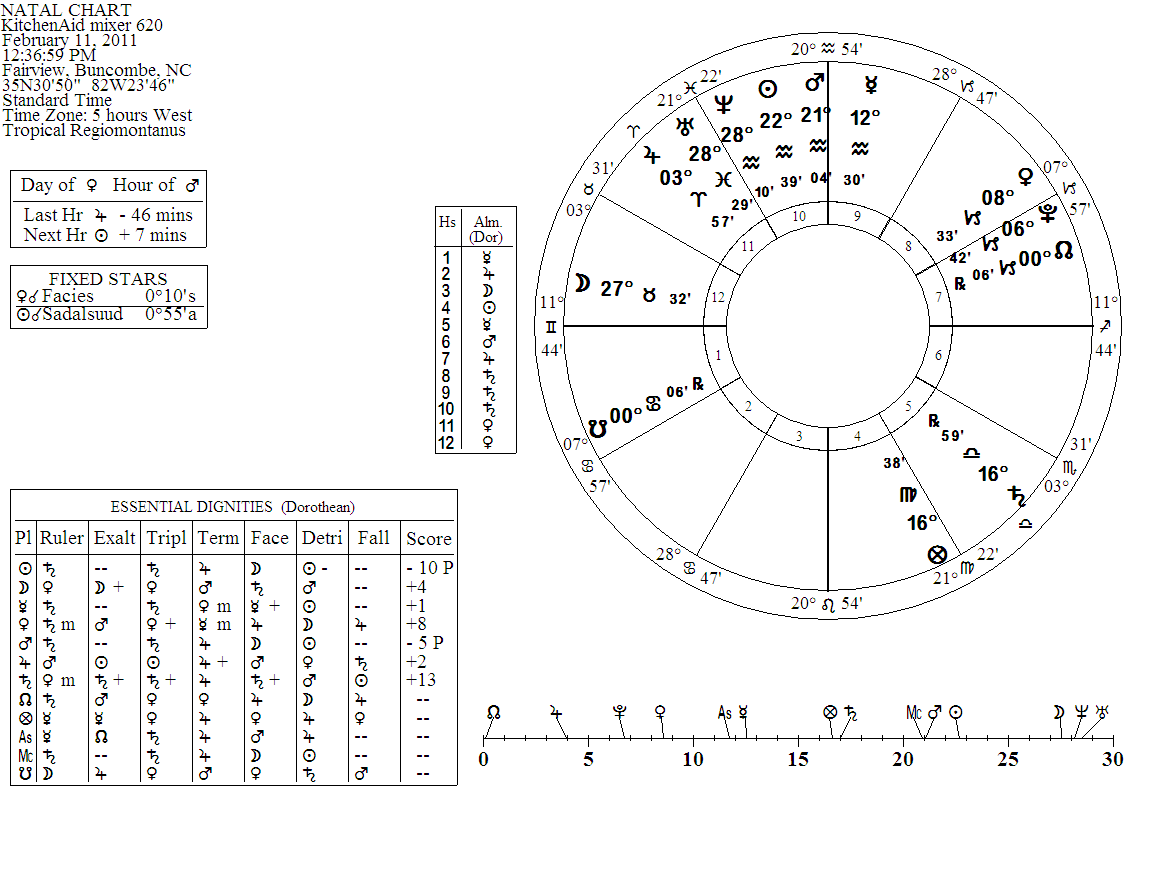
Which brings me to the KitchenAid mixer. Back in 2011, my partner Maggie bought a KitchenAid mixer. Not that she wanted to: her previous mixer had a burned-out motor. However, she got an incredible deal on it, and so she bought it. We did not elect a time.

How do you interpret the chart? First, the time was easy: we took it from the e-mail confirmation that she received from Chef's Catalog. We did not examine the chart at the time. However, looking at it now, the 1st house represents the subject of the event, namely the mixer, and we see the South Node there: not a good sign. The Moon was in Taurus, which we had probably noted at the time in a vague sort of way.However, this chart hangs upon Mars.

Why Mars? Mars is the motor! In a mixer, it dies when the motor gives out, because most of the other components are replaceable. Go onto EBay, and you'll find just about every attachment available. Similarly, you can get many parts from the manufacturer.Here, Mars was peregrine and combust. There was some debate in the Medieval period about whether Mars combust was an accidental debility at all: here the suggestion might be that it may not be as bad as another planet combust, but it certainly doesn't help! That poor Mars is the most elevated planet, and it's a Mars hour, torquing up the importance of Mars. But this is a weak Mars.

So a couple of weeks ago, Maggie went to make bread, turned on the mixer, and the sound was like a car battery dying. One dead motor. The value of the Moon in Taurus was that Chef's Catalog replaced the mixer with only the difficulty of the confusion of the Mercury retrograde period, in which they got it confused about whether she wanted a refund or replacement.

So now, we come back to Pluto in Capricorn. When she got the mixer, even though the model number was the same, it felt different to her. One of the blades she had bought wouldn't fit. I felt the included blades: and they felt lighter weight. In fact, when she bought the mixer, she had bought an extra bowl, and when we weighed the old bowl and the new bowl, the difference was over two ounces lighter for the new bowl.

As we have been seeing for some time, corporations are finding all the ways they can cut manufacturing costs to maximize their profits. Everything about this new mixer is cheaper - and yet its price in the Chefs Catalog has risen about $100 in the less than two years since Maggie bought it, in the midst of this very inflationary period! This is Pluto in Sagittarius thinking on the part of KitchenAid: build cheaper equipment which dies sooner, but has nifty features, thereby hopefully encouraging the customer to buy the latest and greatest because of its still sexier features.

How long before corporations "get" it? Also in Astrology of Sustainability, I discuss the agency of outer planet cycles for change - specifically, that we are in a period until 2020 with no major outer planet conjunctions. Evidently, we are all likely to be slow learners for a while.


Thursday, November 15, 2012

Gaming Models and Presidential Elections

Copyright 2012 J. Lee Lehman, PhD

For many years, I have been interested in mundane methods for predicting the outcome of sporting events. Originally, I worked primarily with William Ramsey's rules. Later, I also worked with Bonatti's rules of warfare. In the latter case, I developed methods for working with presidential elections based on quantitative models: assigning points to each of the criteria used. I believe that this work is vital, because only quantitative models avoid the judgment calls that make historical work truly useful, rather than speculative.

The pitfalls of non-quantitative models was illustrated all too well in Sylvia De Long's 1981 work, Charting Presidential Elections. In this book, she presented a model using Saturn to rule the Democrats, and Jupiter to rule the Republicans. She used elevation and disposition as two of the factors to judge which planet was stronger in the chart for sunrise on Election Day.

The problem? The one advance chart she gave was 1984, in which she predicted that the Democrats would win, instead of 1984 becoming the reelection of Ronald Reagan. Oops. Now - we all will be wrong sooner or later in our predictions. But the point, I think, is that, when you know what the outcome was, it is difficult to be truly objective in rating the charts. Unless you have a friend run the data, then chop the chart information off the print-outs, it's hard to actually retrospectively predict rather than explain.

I made my own predictions for 2012 in August at a talk I delivered to the Northern Illinois Chapter of NCGR. I wanted to share a couple of my slides, to illustrate some ideas about mundane prediction, especially using gaming models.

I would also like to note that the media has given little coverage to the fact that not only were there several of the media statisticians like Nate Silver exceptionally accurate - but so were the betting models. Jamie Partridge has also mentioned this. During the run-up to the election, sites like http://www.predictwise.com/ and http://www.betfair.com/ were showing Obama winning consistently. Predictwise was likewise very accurate on the results for the US Senate.

So: about the astrology. I presented two different discussions: a comparison of natal charts based on chart comparisons from prior elections where we had good birthdata for each candidate.

For example, comparing the last three outer planet transits before the election gave these results:


This wasn't a stunning call for Obama, but given that Saturn aspects seemed more likely in winners, the fact that his last three aspects were all Saturn did argue for Obama. When I counted up which transiting planet aspected the natal chart, I did not break the data out by transited planet: off-hand, Saturn square Saturn seems harder than most.

Another example was the lunation cycle. I saw a number of predictions based on Romney going into the 8th phase as a negative.


This was a technique that was not predictive in this race, although I saw it used by several astrologers as an argument for Obama. Here;s the issue. This graph shows the actual historical count. Romney was born in the 6th phase, which, according to the graph, has more winners than losers. He had just gone into the 8th phase in September 2012. Given the description of the 8th phase in Rudhyar's work, this makes absolute sense as a call for Romney to lose. In the actual data going into this election, there was only a small elevation of losing associated with this phase.

Contrast this with Obama. Obama's birth phase, the 7th, is not historically good for presidential winners, whereas Romney's birth phase was. Obama's phase at the 2012 election had heretofore only been occupied by losers.

We don't have a lot of data points to work with here, so these results so far are just a start.

We have more data for mundane models, and this is what I will review now. My model is based on the following:


The major question is: what charts work? This is my summary slide of results leading up through 2008.


It was typical in the classical period to examine all outer planet conjunctions. Since the Outer Planets hadn't been discovered yet, that meant the Mars-Saturn and Mars-Jupiter conjunctions, as well as the more famous and more powerful Jupiter-Saturn. Here, the Mars-Jupiter and Mars-Saturn would potentially be interesting, because there is always at least one such conjunction between each election. Thus, one cycle of Mars and Jupiter or Saturn can only apply to one presidential cycle.

This being said, that doesn't guarantee that either of these cycles is predictive. In fact, the Mars-Jupiter does not appear to be. Similarly, the prior solar eclipse and the Inauguration Day chart are not predictive, at least using this particular rules of war model. This does not mean that some other model could not use these charts.

We may further note that the Libra Ingress turns out to be one of the more predictive charts: but in reverse. This is what is called a contrarian model: you take the winner as whatever the model deems the loser.

Examining all these charts together gives the following prediction, based on the historical model:


Going back to 1912, this combined model has been wrong only three times: in 1932, 1952, and 2008. It is interesting that 1932 was the first election after the onset of the Great Depression, and 2008 the beginning of the Great Recession: major economic downturns which clearly were outside the bounds of the model.

My future concern - that Election Day charts may become obsolete as more of the country moves toward early voting - may in fact be borne out by this year's data. The last time both Election Day charts were wrong was 1972: and these two charts have only both been wrong twice in the last century. We shall have to watch this trend.

References

Bonatti, Guido. The Book of Astronomy by Guido Bonatti. Trans. Benjamin N. Dykes. Golden Valley, MN: Cazimi Press, 2007.

Brady, Bernadette and J. Lee Lehman. Twelfth century castle besiegement in sport. The Astrological Journal 39(3): 27-44, 1998.

DeLong, Sylvia. Charting Presidential Elections. Tempe, AZ: American Federation of Astrologers, 1982.

Ramesey, William. Astrologia Restaurata, or, Astrologie Restored Being an Introduction to the General and Chief Part of the Language of the Stars : In 4 Books ... : With a Table of the Most Material Things Therein Contained. London: Printed for Robert, 1654.


Sunday, November 11, 2012

The Indianapolis Explosion

Copyright 2012 J. Lee Lehman, PhD

It is odd waking up to the news f an explosion which takes out a house in a normally quiet city. We expect these things in war zones, and so all the descriptions of the scene picked up that image. From an astrological standpoint, the first thing that we want to know is what caused it. In this case, the chart gives a pretty good indication that the initial theory of a gas explosion is probably correct.

Data given bu USA Today, 11 November 2012.

First we see the Leo rising 0 fire. That is what all the preliminary pictures focus on: the appearance of the neighborhood as if a fireball had hit. The ruler of the chart is in the 4th, with dignity only by Face: the dignity that I have referred to as having the keywords fear and anxiety.

The presence of Neptune at the 8th house cusp does look like the gas leak scenario. Jupiter, ruler of the 8th house cusp, is not only in an air sign (gas!), but doubly debilitated: by being in Detriment, and being retrograde. That leaves little of its more benefic qualities, and more of the inappropriate expansive ones.

Saturn is at the IC. Were this a horary question about buying a house, that Saturn would immediately make me think there was something structurally wrong there.


Wednesday, November 07, 2012

What has the 2012 Election Taught Us?

©2012 J. Lee Lehman

First, congratulations to all my friends and colleagues who dared to predict the presidential election. I congratulate everybody, because the first step is to try.

I also hesitate to congratulate only those who predicted correctly because this kind of prediction is difficult, and fraught with problems. It is in the spirit of humbleness that I would like to address some of the problems I see in this prediction process, as well as to herald some things that I think we as a community are beginning to get right.

In the category of right, I congratulate the Political Astrology Blog and Chris Brennan and Patrick Watson for their work through the last two elections in providing a resource for predictions made, and timings recorded. It is extremely useful that the information from one election is not just quietly disappearing before the next cycle: and the next. We can only learn from developing a historical database. It is also for this reason that I urge everyone who has posted predictions or discussions of this election to not take them down. I know that nobody really wants to keep remembering their mistakes, but there is still gold to be mined in understanding both the "correct" and "incorrect" analyses - because hardly anybody gave single reason predictions. I would claim some small credit for Kepler College in helping to initiate a more serious discussion of these matters.

Here are some ideas I would throw out as important.

There are two psychological factors that we have to keep in mind that have major bearing, not only on our predictions, but those of the media, and citizens at large, whether of the country in question, or not.

  • It is an extremely well documented observation that virtually everybody makes the mistake of believing that other people agree with them more than is actually true. I have observed and commented for some time that there has historically been a high correlation between who astrologers predict will win with whom that astrologer will or would vote for. If we understand this within the context of this psychological tendency, we understand the very real peril: that if we believe that the universe is ordered, and we are right, then of course the universe will work out according to our own beliefs. While not a fully conscious process, this represents a considerable danger in making predictions.
  • When, as today, we are engaging in the post-election discussion, the tendency when one is wrong is to find a factor in the charts that one examined that could be construed as going in the opposite way, pounce on that factor, and then explain one's wrong prediction as being a result of that. So far, this may be plausible. But the real error is then the all too human tendency to believe that, having found the magic bullet, that one's prediction is transformed into a correct prediction, for having been explained.
In fact, predicting the outcome of political elections means using astrology in a fundamentally different way than we normally do. Natal astrologers are simply not generally called upon to compare two charts and see which one would be victorious in a contest held upon a particular day.

This simple reality is further complicated by the fact that everybody had a roughly 50-50 chance of being right or wrong. Thus, we are confronted with the probability that some of the correct predictions for Obama were actually fundamentally flawed in analysis and right by chance, whereas some of the predictions for Romney were just slightly incomplete, but primarily correct. How does one tell the difference, especially since we only repeat this exercise at four year intervals?

For now, let me address some particular factors, in the hope that they can help the thinking process for future elections.
  • The prediction of two-party models is completely different than parliamentary models, because only two party elections resemble the warfare models of which I am fond. If there are multiple armies on a battlefield, each one is not fighting all others: they are already aligned as allies, which is not how multi-party systems work.
  • I think we have to come to agreement for the future that if the US system is that the actual victory occurs through the Electoral College, that winning the Electoral College is the measure of a correct prediction. Frankly, we don't have enough data for a model of when an election is split between popular and Electoral College. However, I have to admit that I am being dragged kicking and screaming into developing some respect for the Electoral College idea. Had a hurricane or earthquake actually occurred on the day of the election, thereby significantly lowering a populous state's voting; or had a state referendum significantly changed the voter turn-out in just that one state; then the popular vote might not actually be more "just" than the Electoral College.
  • This election was the first failed case since Al Morrison pointed out the theory: that people nominated under a void of course Moon do not win the election. Obama was, and he did. My comment on this is twofold: first, there are no single factor arguments that I know that will work absolutely all the time. The second point is that the void of course has, imho, been blown up way out of proportion. It is merely one of the ways that the Moon can be afflicted. We must study them all.
  • This leads into the next issue: is there any critical event prior to the election itself that determines the outcome of the election? We don't often discuss this matter of multiple events surrounding an event, but we have the time a person announced candidacy, the time the election campaign is established, each of the primaries, the date of the primary at which the candidate receives the votes needed to become the candidate, the time that this is declared by the media, the time the nominating convention begins, the time that the candidate is announced as winning the nomination, and probably several other dates I am forgetting. Are any of these fail-safe predictors of the results? I tend to view these matters in the spirit of electionals in a string of related issues like a relationship (where one can do charts for the time of meeting, the first date, the first sex, moving in together, marriage, etc.): the most important thing may be defensive charting: that none of these event can predict a success, but any of them could preclude one.
  • Horary: it's time to give it up. Sorry, but let's stop kidding ourselves. In a world of seven billion people, the idea that any one of us citizens has the special pipeline to the truth about this is delusional. This cannot work, because of two irreconcilable problems: that we cannot know when the question was asked for the first time (making all subsequent attempts bogus with random access results), and we aren't really any more special than any other citizen of the Earth. I was especially disheartened by reading an argument that perhaps one gets the right answer if one has greater virtue. No comment. But I think the fact that there are many astrologers (me among them) who adore horary doesn't make this an appropriate technique.
  • It may do well for Americans to study European parliamentary elections as a model for the primary season. We simply don't have a model for what to do with multiple candidates.
  • In a world of early voting, it's time to revise our models. Dixville Notch is now a lovely historical asterisk, when literally millions have voted before those intrepid few have stayed up for their election night party. We may see a decline of importance of election day charts as being predictive, because so much of the voting has already occurred.
I believe that successful work on elections will occur through the combination of mundane techniques, and natal work focused around learning the appropriate factors to compare between timed charts of candidates: a database which now stands at seventeen cases where we have good data for both candidates. This is slow, hard work.

But most of all, I encourage my colleagues to persevere, always using caution about applying hindsight instead of foresight.

Saturday, October 27, 2012

Think like a Classical Astrologer!

Copyright 2012 J. Lee Lehman

It happens all the time. Every time an astrologer interprets a chart, a creative process must occur, linking astrological symbolism to the person, question, or event under study and interpretation. However, the context in which this creation occurs can be very different from astrologer to astrologer.

As more astrologers have begun to explore classical (also called traditional) astrology, it is sometimes not entirely clear how it is necessary to change one's thought processes. Here, I want to give just a brief explanation of how this works.

Many students of astrology have experienced what we might call the "blank slate" state - you've studied all those various books, but upon encountering a new chart, you freeze: now, what do I do? This in fact is one of the major dividing lines in astrological education: between the people who have broken through this barrier and those who have not. Until you do, the only recourse is to attempt to use cookbooks to provide enough of a story to fill in the words that somehow don't otherwise trip easily off the tongue.

But how that barrier is breached is incredibly important, because it reveals the type of astrology that can then come forth.
  • If one approaches astrology through myth, then the way to move through to interpretation is to carefully consider the Native's situation, and to find the myths that apply the story for the person's situation. Then it remains to tell the story, and to adapt it to the conditions at hand.
  • If one wants a psychological approach, one listens carefully to the client to understand the psychological matrix of the client's circumstances,  and from these, one uses the astrological symbols to guide the psychological process and exploration.
  • If one takes a classical approach, then the first stage of the delineation is to ascertain the historical precedents for the situation, so that one has a guide to the means of interpreting the astrology of the moment, and what it portends.
In a sense, these three methods share an approach: the first stage of the process is obtaining the general map of the terrain, so that the interpretive process may begin. It's useless to look for Chicago, Illinois on a map of Europe. The first stage of the process always sets the general parameters for the search for appropriate knowledge, tools, and information.

To give an example, what rules writing and publishing?

Modern astrology is an overarching term for the astrological methodology that has developed since the 17th century, and primarily in the 20th century and beyond. Lacking one cohesive lineage, the modern practitioner has no one simple path to answer this question. The astrologer may appeal to an authority, such as a published book of rulerships, or to a listing of items rules in a cookbook. Or as likely, the astrologer may simple try to "logic" the answer. But how does one do that? Often, one tries to come up with an analogous item: so one can think about writing involving words, solitary activity, but publishing brings it out into the world, etc. In this way of thinking, there may be no right or wrong answer, but if this question has come up because of a horary, the result of this process may produce a right or a wrong prediction.

In classical, the process is different. The first step is: what has anybody said about this in the past? It was to facilitate these questions that I originally published The Book of Rulerships, which lists what a number of previous classical authors have said. While this work, being some twenty years old, did not encompass the many works of classical astrology which have been translated since, it is a good starting place. I have also published a supplement to it on my website. Here, we discover the following:


Rulers
Item Ruler Reference
Writers 12 AB-276
Writings ME LI-139
Writings ME D2-025
Writings GE KB-016

For example, al-Biruni (the abbreviation AB) said that writers are ruled by the 12th house. Perhaps this refers to the solitary activity of writing. That number after the abbreviation gives the page number in the cited reference. So Lilly (LI) says that writings are ruled by Mercury on page 139 of Christian Astrology. Kirby and Bishop (Bishop, John, and Richard Kirby. The Marrow of Astrology the Second Part. Wherein Is Contained, a Table of Houses, Calculated for the Latitude of London: With Tables of Semidiurnal and Seminocturnal Arches. Also Tables of Twilight and Mundane Aspects; and the Whole Doctrine of Nativities, Laid Down in Twenty Genitures, According to the True Intent and Meaning of Ptolomy, Wherein Is Discovered the Errors of Argol, Regiomontanus, and Others. The Like Never before Done in English. By John Bishop, Student in Astrology and Chimistry. microform. printed for Joseph Streater near Paul's-Wharf in Thames-street and are to be sold by the booksellers in London, London, 1687.) give Mercury as ruling writing.

Once one has these classical precedents in hand, then one has to decide which of them to use, or if a rethink of the concept is necessary in light of modern technological or societal changes.

In fact, the issue of rethink is always present in astrology, whether ancient or modern. Consider gay marriage! It simply didn't exist as a possibility when any of these sources were written, including the 20th century rulership references!

The primary difference in thinking classically is knowing to start with what astrologers have known in the past. This gives a firmer grounding to making any decision about adapting the precedents, instead of simply using them. This may require extra works, and a couple extra steps, but laziness is no excuse for sloppiness.


Saturday, August 11, 2012

The 5th House in the Current Stock Market

Copyright 2012 J. Lee Lehman, Ph.D.

For years in my personal practice, as well as in Martial Art of Horary Astrology, I have followed the standard pattern of referring to the stock market as a 5th house matter: gambling, in other words.The idea was: when you invest in the market, you are engaging in a practice similar to traditional gambling: you may have a model you are working with, or technical factors, but your "bet" still involved the Wheel of Fortune: Lady Luck. Thus, astrological practice would make this unequivocally a 5th house matter.

I want to call attention to the fact that this may not longer be true. The reason is simple: computer trading. A recent article in the BBC pointed out just how much computer trading is going on. The basic idea is this: there is now a huge amount of computer trading going on, where programs are actively looking for anomalies in market price, and trading accordingly. Computers can do this on a scale vastly beyond the capability of a human being, or even a conventional brokerage house. A computer program that has access to market data in real-time can perform so many calculations per second that there need not be much "intelligence" there - just a lot of horsepower to perform crude but numerically overwhelming crunching, which then itself becomes a trading strategy, because it is the computers initiating the trades. I would then ask: apart from when the programs glitch, how much randomness or luck is left in the market?

Given this question, is stock trading any more a 5th house activity? I am personally reexamining this issue in terms of my own portfolio, but I am also going to begin to take this into account in my astrological advice.

In fact, I have noticed a definite shift in electional work that has been building steam over the last decade or more. The basic question is: when the other "party" is a computer, do the traditional astrological rules apply?

Saturday, April 16, 2011

Is Horary Really Technical?

Call this an "open answer" instead of an "open question." There are many ideas that natal astrologers hold about horary that are frankly just plain strange. They are also largely artifacts of ignorance, which is not necessarily the fault of the person holding the opinion, but may well be the fault of their teachers, and of many of the people who have authored books on natal astrology.


Today, I received an e-mail from a person who was simultaneously intrigued and nervous about studying horary, because she was afraid it is too technical for her to grasp. Here is my response.


I don't see horary as any more technical than a host of things I have studied. What I would say is that horary is actually very procedural. All that means is that you call a spade a spade.

In natal, does saying that Leo is a fire sign mean natal is technical? Because, within the classical period, natal astrology was every bit as "technical" as horary.

So I guess I'm not sure what you mean by "technical." Does it run by rules? Yes! But what about that makes it problematic?

Imho, the following statements are true:

1. Most astrology books and astrology courses are written by well meaning people who don't know how to either write or teach. This is not a reflection of their moral or intellectual worth, but simply a statement that you can hardly expect people to intuitively know how to do either skill well. The same thing happens in martial arts, when people study for a while, and then are thrown in as teachers, without teaching them how to teach. The results are rarely satisfactory for either party.

2. Part of the evidence for 1 is that the knowledge conveyed is inadequate when it cannot be applied outside the examples given in the book/class. Many authors make statements that are so vague that they either apply to every chart, or no chart, and the poor student is left to wonder what they misunderstood. It is always easier to believe that you cannot understand the author - which is your fault! - than that the author got it wrong.

3. The real problem in writing and teaching is that most authors and teachers are not actually thinking about how to engage in astrological reasoning, and instead are attempting to teach only by applying their own knowledge as if it were drawn out of a barrel randomly rather than systematically applied.

4. If you don't teach systematically, nobody learns anything, except by attempting to reverse engineer.

5. Good teaching requires a defined curriculum, where the student is clear about what the purpose of the instruction is, what is expected of her or him, and what constitutes closure, at least in that particular course. Classes which continue indefinitely have a habit of becoming either entertainment or dependencies, rather than learning.

So, to my question to you: what is wrong with "technical," that this should be an impediment to learning?

Do you have problems following an instruction like, "Raise your right hand?" Because that is technical.

Do have have a problem with logical reasoning, like, "If the Moon is in the 8th house, then the Querent may be thinking about death?" Because reasoning is technical.

Are you concerned that you could never learn all the "rules?" No problem. Nobody does. As with law, the important thing is not memorizing, but knowing where to look them up.

Do you have a problem because you don't know why that statement about the 8th house might be true? In that case, I'm afraid no astrology will ultimately be satisfying for you, because while it may be possible to historically date the statement, no astrology brings you to the primary cause or complete truth about anything.

Is the comment about technical really a statement that you are afraid to put your astrological knowledge and reasoning to the test of a crucible in which you have to declare a judgment than can be then declared to be either right or wrong? In that case, then how much faith do you really have in what you have learned?


Beyond this particular person's concerns, the other great dig at horary is that it legislates against free will. It doesn't. Fate is merely the statement of what happens when you have neither the time, the will, nor the inclination to exercise free will. And that's the problem. The exercise of free will takes energy, will, and time, commodities that are often in short supply. And of all of them, the exercise of the will, or intention, is probably the commodity in the shortest supply. People are not encouraged to really think carefully about their options and make a considered choice between options that have been seriously studied. We are encouraged to pick between the red or the blue on impulse, not think about whether we really wanted that new car, or whether it is a good choice based on environmental considerations.

The expression of free will is difficult, because we have to think, we have to question, and we have to discover a path that nobody tells you to take, and nobody gives you very many points for choosing. I am completely in favor of free will, just as I know it is in short supply.


Horary "works" because it is the measure of how things will unfold in the absence of free will. Thus, horary is not an opinion about free will, but about how people operate when they themselves have abrogated free will.

Monday, January 10, 2011

The Arizona Shooting

©2011 J. Lee Lehman

Before anything, I have to express my personal dismay that we even have such astrological moments to interpret. Shooting politicians is not a mark of a civilized society, no matter what the Hatriots, who have furthered their careers and pocketbooks, may think. Rhetoric kills.

I have to admit to a personal connection: my parents had retired to Green Valley, AZ, a town just south of Tucson. Accordingly, I have visited Tucson numerous times. My parents had bought from Giffords' family business. I know the addresses given. Giffords was elected the year after my father died, but I have no doubt he would have voted for her.

It took a while to sort out the chaos surrounding the shooting of Congresswoman Gabrielle Giffords two days ago. The time has been given from 10:00 - 10:11 am, but the difference is not that meaningful in examining the chart. Can it tell us anything useful about the event, and what will come of it?

At 10:00 am, Saturn is much closer to the 8th house; at 10:00, the Moon is much closer to the Ascendant, but with either chart, these are the two great symbols we see. When I first read the reports, and learned of the death of Judge John Roll, I wondered whether in fact he was the target. We have since learned otherwise.

Chart for the shooting of 20 people.
How should we view the chart astrologically? I would propose that one very good way to do this is as a decumbiture. There are two major unknowns at this point: the prospect for Giffords' recovery, and the disposition of her alleged attacker. Quite honestly, I am far more interested in the former than the latter.

If we do so, here's what we can see. From what we know at this point, Giffords was the target of the shooting, and, as the "subject" of the event, the 1st house. She was most certainly not the only victim of this event, but what we can all agree is that, had it not been for the murderer picking her as a target, all the other people would be alive today. Those other victims, I suspect, are shown by Saturn, so close to the 8th house cusp.

The Moon is right at the Ascendant. (Remember, the time uncertainly means that the Moon could have still been in the 1st house, but conjunct the Ascendant nonetheless.) The Moon rising in electional astrology represents change - and this certainly represents a change in her status! The partile conjunction of Jupiter-Uranus, with the Ascendant being ruled by Jupiter spells out the suddenness of the event.

The good news is: the Moon and Jupiter (as ruler of the 1st) are not in approaching aspect to Venus, ruler of the 8th. This would be the primary argument for her death: if the Ascendant ruler of the Moon was approaching an aspect to the ruler of the 8th. In fact, the Moon was separating from the square to Venus.

The next consideration is the degree of her recovery. I think she will make a good one. Jupiter is dignified in Pisces and, given the relatively late degree, it is also dignified in Aries. With the Moon separating from, rather than applying to, Neptune, I believe her medical team is able to read her condition well. The 6th house, her "disease," is ruled by the Sun, which is peregrine. When the ruler of the 1st is stronger than the ruler of the 6th, it means that the patiet's vitality is stronger than the disease. This is alo encouraging.

Jupiter also rules the 10th house of treatment, which is a good thing for her. There will be some bumps along the way, but this would take a thorough analysis of the critical days to examine this question further. But with the Ascendant in a mutable sign - those which used to be called common - I should think that her recovery won't be as fast as we would hope, but with the dignity of her ruler, I think we will be heartened in the end.

Wednesday, July 07, 2010

The 1848 Uranus-Pluto Conjunction and Franz Joseph of Austria

©2010 J. Lee Lehman

1848 rattled Europe more than anything since the French Revolution – and for many of the same reasons. To begin with, Karl Marx and Friedrich Engel's Communist Manifesto was published. Riots, uprisings, revolutions and protests broke out across Europe: France, Hungary, Germany, Italy, and the Balkans. The California Gold Rush began. Switzerland, France and the Netherlands got new constitutions. And Wagner began writing Der Ring des Nibelungen (the Ring Cycle). And furthermore, the Irish potato famine was still running its course, resulting in staggering death and emigration.

Examining the chart for 1848 for Vienna (the angles will obviously differ in other parts of the globe), the Sun was in a partile conjunction to the South Node! One of the symbols of the Sun is the king: and here, authority figures were being destroyed – or at least challenged. In much of Europe, this conjunction occurred in or near the 10th house cusp, reinforcing that theme. The Aries Ingress was just a few hours after a Full Moon eclipse. The very powerful signature rocked the establishment of the time – but mostly, it didn't break. By now, Pluto was at 25 Aries – it had mostly run its course through the sign. The remainder of the period would be devoted to the reactions of the establishment to the challenges of 1848. The German rebellions were done by 1849. Hungary declared independence from Austria in 1849 – but that failed because Austria was victorious – with a little help from Russia. The new republican government in Sicily was extinguished in 1849. And in 1851, Louis Napoleon dissolved the National Assembly, a move which allowed him to declare himself Napoleon III the following year.


When we compare 1848 and 1849, here drawn for Vienna, we see the difference between the South Node and Saturn afflicting the Sun. What's the difference, since both are malefics? The South Node is destructive – and that eclipse doesn't help. Lest you assume that this is a common occurrence – think again. From 1500 – 2050, this
is the only year that the Sun was partile conjunct the South Node at the Aries Ingress. In two other years, the South Node was within a one degree orb, but in Pisces: 1513 and 1755. 1513 was the year that Machiavelli wrote The
Prince
, an influential document on the nature of kingship! 1755 was the year of the Lisbon Earthquake, one of the deadliest earthquakes ever, especially when one factors for the relative population size then and now.


By contrast, there have been five other Aries Ingresses since 1500 where Saturn was within two degrees of conjunct the Sun. Here's how they worked out:

  • 1555 (Saturn in Aries) featured the Diet of Augsburg – the congress of German princes which stabilized the existing religious division of the princes between Catholicism and Protestantism.

  • 1643 (Saturn in Pisces) was during the English Civil War. Obviously, Charles I was afflicted!

  • In 1702 (Saturn in Pisces) William III died; his daughter Queen Anne succeeded, becoming the last British monarch of Stuart descent before the Hanoverian Succession

  • In 1761 (Saturn in Aries) George III was crowned following the death of his father the previous year.

  • In 1908 (Saturn in Aries partile conjunct the Sun) there was both the Young Turk Rebellion in the Ottoman Empire, which succeeded in restoring an earlier system; and the ascension of Emperor Pu Yi in China, often called the Last Emperor.


As one can see from the list, the presence of Saturn conjunct the Sun alone doesn't depose a king. With the exception of 1643, these were all peaceful transfers of power – or confirmation of power, in the case of the Treaty of Augsburg. One does get the sense that it may be setting up a final run, so to speak.


Austria was a good case in point. The political unrest of 1848 cost Metternich his job. The Emperor Ferdinand was ineffectual, the Hungarians were already rebelling, and also portions of Austrian-ruled Italy. The military wanted a strong Emperor, so they arranged for Ferdinand to abdicate, to be replaced by Archduke Franz Joseph, his nephew. The unrest of 1848, not to mention the war on two fronts, meant that Franz Joseph was initially forced to grant a new constitution in 1849 – and to give the impression that he was a moderate or a reformer. Austrian forces were victorious in Italy, and Franz Joseph obtained aid from Russia to defeat the Hungarians. He then repudiated the constitution, and ruled from the position of absolutism, until his death in 1916 – not quite the last Emperor, but within two years of being so.


Franz Joseph's ascension occurred under the Libra Ingress of 1848. Here, we see Saturn-South Node prominent at the MC, with the Sun at its Fall at the IC – not an auspicious place, for a new reign. But Saturn blanketing the MC does not suggest that reform was really on Franz Joseph's mind. The MC ruler was Jupiter in Leo – that looks far more like the absolutist that he became than the reformer he at first appeared to be. And he became quite popular, the people represented by the Moon in Leo is approaching the conjunction to the Emperor.

The Saturn-South Node conjunction at the MC did show that things were beginning to unravel. Franz Joseph's only son died in a tragic event, probably a suicide. His next successor, his nephew Franz Ferdinand, was assassinated, triggering World War I, as we saw in the last chapter. Yet Jupiter has dignity by Triplicity: he had a long reign personally.


The chart for 1849 for Vienna shows that Austria's enemies, ruled by Mars in Aquarius, were not so strong as Austria – Venus in Taurus. That Venus also ruled the 9th – and there, his strategic alliance with Russia sealed the victory over the Hungarians.


As an aside, we have already seen that legislatures are ruled by the 11th. Here, the ruler of the 11th – the Sun – is at the Portals of Death – the 7th house cusp – open enemies, not only death. Franz Joseph's victory over the Hungarians effectively killed the power of the legislature.


Thus, we see that, while the Uranus-Pluto conjunction of 1848 had the promise of rebellion about it, that rebellion wasn't stable, and in the immediate future, produced a conservative backlash. Uranus allows people to have a taste of change - but it does not give the guarantee of change.

Saturday, June 19, 2010

What is a Spiritual Disease?

In the Martial Art of Horary Astrology, I outlined some of the classical rules for determining whether a disease was physical or spiritual in nature. To reproduce the table on page 157, here is the traditional distinction.


Table One. Typical configurations for physical and mental diseases, as described by Lilly and others.

Physical Mental/Spiritual
Ascendant and Moon afflicted; their rulers not afflicted. The Ascendant and the Moon not afflicted; but their rulers afflicted.
Mars or Saturn afflicting the Moon, but not the Ascendant. Mars or Saturn afflicting the Ascendant, but not the Moon.
Jupiter in the 1st or 6th Ruler of the 9th or 12th in the 6th (witchcraft)
Ruler of the 1st in the 6th Ruler of the 6th is Mercury (witchcraft)
Moon or Ruler of the Ascendant in the 12th. Ruler of the Moon or Ascendant in the 12th.

One of my medical students recently asked me about this table, noting that this does not express his experience. I have to admit: this doesn't express my experience either. And it is precisely this point that I want to discuss.

First, I would express the following: it is a mistake to take any author as being 100% right about anything, whether an astrological author, or an author in any field. I would add a corollary: it is extremely important to understand the historical context of astrological method in order to understand whether or not the method even applies. Here, I think this point is the crux to understanding the problem: that our modern contours of disease do not map one-on-one with older theories of disease.

This week, I have been working with two women about health issues: and by chance (!) they both have ten degree Virgo Moons. Accordingly, both have had Saturn transiting their Moons, so by Lilly's rules, they would both manifest physical diseases. With Saturn separating from the conjunction, we are reminded of two things. First, that Saturn transits often have a "whole-sign" influence, where, even though the transit is officially over for both of them, the "mess" is still being cleaned up, as the Saturn completes its transit of Virgo. The second is that often Saturn shows the development of the disease, not necessarily its culmination.

The younger of the two has been diagnosed with throat cancer, and has just had her surgery scheduled. In her case, Taurus is the sign of her 6th house cusp, certainly appropriate for the nature of the cancer: and suggesting that this disease is signature for this chart: not an incidental event, but part of the major theme of her life. Saturn in Cancer is in her 8th - the disease cancer could be the cause of her eventual death. (That is not the only possible scenario, however.) But in her solar return, the most afflicted planet is the ruler of the Ascendant - arguing for a mental/spiritual disease at this time.

Now there are those people, especially within the New Age movement, who argue for the mental/spiritual side of cancer. I forcefully disagree. Not only has there been a massive increase in cancer in the 20th century correlating with the increased use of a series of carcinogenic substances like benzene, but there has been research for over eighty years pointing out these correlations. (For a fuller exposition of this, please see: Davis, Devra Lee. The Secret History of the War on Cancer. New York: BasicBooks, 2007.) With greater exposure to chemicals, more people are getting cancer - whatever their psycho-spiritual state.

It is interesting that in the 17th c. works on astrological medicine, the emphasis was on predicting whether the patient would be cured or die. It was not on diagnosing the disease by any disease categories still in use. Thus, William Lilly or Richard Saunders had no "model" for cancer. So we are somewhat off the hook about trying to explain how to use astrology within the context of soaring cancer and diabetes rates. But would Lilly and Saunders view this patient's cancer as physical, or mental/spiritual? They certainly knew cancer. Lilly describes caring for his employer's wife who had breast cancer, and it is a wrenching description.

And yet - there is also testimony to the psycho-spiritual aspects of cancer. (for an interesting exposition of these ideas, see, for example, Schulz, Mona Lisa, and Christiane Northrup. Awakening Intuition : Using Your Mind-Body Network for Insight and Healing. New York: Harmony Books, 1998.) Schulz's experience as a medical intuitive argues for at least a spiritual dimension to the process.

How do we square these two approaches? In all likelihood, our intrepid patient was exposed to chemical toxicity - something that is nearly impossible not to envision, given the chemical load which is being discovered in everybody. (For more information on chemical load, see Baker, Nena. The Body Toxic : How the Hazardous Chemistry of Everyday Things Threatens Our Health and Well-Being. New York: North Point Press, 2009.) She, like the rest of us, is walking around with a chemistry set of substances in her body. She hits a solar return in 2009 with a Venus-Mars conjunction at the shipwreck star Scheat, just shortly after Saturn completed the transit to her Moon, and with the South Node in the 6th. The cancer starts growing. Her natal 6th house shows the place. The 2009 solar return has that transiting Saturn opposite solar return Moon, so again, the problem is of the body. And yet, the ruler of her Moon and Ascendant is in the 12th, being afflicted by Neptune. So we see a mental/spiritual connection as well. So we have a mixed physical and mental/spiritual disease - which happens a lot. Mixed astrological messages again!

Our second Moon at 10 Virgo has cataracts and glaucoma. The doctors have already been doing eye surgery on her, reflecting the fact that Saturn had been in Virgo for a while. In her 2009 solar return, the Moon was afflicted by Uranus, but the dispositor of the Moon was afflicted by Neptune. Mixed indicators again.

It's harder to square the issue of mental/spiritual aspect to glaucoma and cataracts than for cancer - although still some might argue for some metaphor around seeing. But I would merely add that this woman is 83 years old. Does age trump metaphor?

Another woman I worked with on cancer, this time with natal Moon in Pisces, received her diagnosis just as Saturn had transited into Virgo. Her cancer is one that was unheard of until the 20th century, and has been correlated with chemical exposure. In the year of her diagnosis, the solar return Ascendant was not afflicted, but its ruler Saturn was in detriment in Leo, in a partile opposition to Neptune, and posited in the 8th house. That affliction to the ruler of the Ascendant makes this a spiritual disease by the old rules, but I'd call it chemical exposure, which sounds pretty physical to me. Her natal Moon is afflicted by Saturn, so at least there we have the physical affect: and her Saturn is in Virgo, so we begin to see something of the timing.

In all these cases, we get a somewhat mixed read for physical vs. mental/spiritual. So what is going on, and are the classifications even meaningful?

To answer this question, I think we have to return to to sociological context of the old rules. From the Roman Empire to the 16th century, the prevailing European model for "health care" was the contract for a cure. In this legal system, a patient and a healer actually created a legally enforceable contract, whereby both parties stipulated what a "cure" would look like (for example: being able to walk, but perhaps with a limp), along with the price for the cure. If the healer couldn't effect a cure, then the patient didn't need to pay, except for medicines. This practice put a premium on the healer being able to not only diagnose a disease, but also that it could be cured on a physical level. This contract explains the popularity of astrological medicine, which could help to determine the curability of a condition. If a patient's condition could not be cured, there would be no payment - so the physician was anxious to know whether a case was worth the effort.

Within this system, the answer is obvious: a physical disease is not one caused by physical means, but one that can be cured by physical means: herbs, baths, surgery, etc. A mental or spiritual disease was one which should be referred to other practitioners - because then prayer, exorcism, talismans (i.e., magic), or other non-physical means of cure would be appropriate.

Once we understand the context, then we can also realize that the boundaries between these categories of disease morph in different historical and sociological circumstances. We may understand cancer as a primarily physical disease: but then, spiritual insight may help in some cases.

Every time you look at a list of astrological rules: for determining the rules for marriage, or for whether the patient will live or die, or for moving house, the student of astrology is almost always confronted with a chart that has mixed messages. This can be very frustrating, especially early on in the learning curve, because the budding astrologer doesn't know what to do. Oftentimes the answer is: both arguments are true. A disease can be both physical and spiritual. Going down one path without the other produces an incomplete, partial or temporary recovery.

Monday, April 26, 2010

The 960 Year Cycle that Couldn't

©2010 J. Lee Lehman

Great conjunctions are any series of conjunctions between superior planets only. This is the system in Western astrology that moved the study of mundane past the yearly agricultural cycles into the longer cycles necessary to understand culture as an historical process, not merely a seasonal one.

The idea of longer periods was not new: the Babylonians had divided the world into three time periods as early as 1000 BCE.1 But it wasn't until a couple of centuries later that the Babylonians achieved the ability to predict the planetary positions in advance: an impressive technological advance, but one that drew away the power of the gods and goddesses to write new messages in the sky.2

What differed with the Arabic material was greater precision in the ability to calculate forward and backward, and its relation to only one astrological phenomenon: the successive conjunctions of Jupiter and Saturn. The full Jupiter-Saturn cycle was declared to be a great mutation of 960 years, which, at 20 years per conjunction is a total of 48 total conjunctions, averaging 240 years per element. Quickly doing the math, 12 conjunctions per element should mean four conjunctions in each sign per pass – but this doesn't work out so neatly in practice. For example, in the just completed Earth Triplicity mutation, there were actually nine conjunctions in Earth – three to each sign. According to Masha'allah (fl 762- ca. 815) in On Conjunctions, Religions and Peoples, each change of element (mutation) was associated with changes in government.3 These ideas were further elaborated to include both political and religious changes.4 Not only was the Triplicity considered, but also the Quadruplicity:

“If their [Jupiter-Saturn] conjunction is in the tropical signs, it indicates universal changes. If it is in the fixed , it indicates the firmness of their condition, and the changes will be toward prosperity. If it is in the corporeal , the matter in this case is middling, and this indicates that at the time of their conjunction most of the prosperity is in the countries of Jupiter, and the corruption in the countries of Saturn.”5

It is almost impossible to overemphasize how important the triplicity of the conjunctions was in interpretation. Abu Ma'shar (c. 787-886) discussed this in detail in his work, On the Great Conjunctions.6 He specifies that the sign in each triplicity that is furthest from Aries is strongest: thus, Sagittarius is the strongest fire sign, and the same for Pisces, Aquarius and Capricorn. This idea of the relative strength of the three signs within an element is also applied in medical astrology.

Abu Ma'shar was clear in stating that the understanding of the Jupiter-Saturn cycle was concerning beginnings, because this combination brings order. Mars added to the series shows destruction, which produces the end of things.7

How accurate is this description of the cycle using our modern astronomical equations? The results are shown in Table 1.

Table 1. Iteration of the “960 year” Jupiter-Saturn cycle in practice. This shows the first conjunction within the fiery Triplicity in each era.


Year Position Years elapsed
25 BCE 3 Leo --
769 CE 0 Leo 794
1603 8 Sagittarius 809
2338 2 Sagittarius 735


The first problem we encounter is the presumption that the first instance of the Fire signs, considered the starting point of this cycle, would always fall not only in Aries, but in the first Face (i.e., 10 degrees) of Aries, or at least some fire sign. It doesn't. For the cycle beginning 1603, none of the conjunctions occurred in the first ten degrees of Aries. So does that mean that round doesn't count? We're still in it in 2010!

If we restrict the positions to the first Face of Aries, and not the first conjunction in the Fire signs, then we get the following results:


Year Position Years elapsed
114 6 Aries --
908 4 Aries 794
1702 6 Aries 794
2497 4 Aries 795


Table 1a. Iteration of the “960 year” Jupiter-Saturn cycle in practice, allowing only Aries as the starting Fire sign.

Here we see that the presumed length of the cycle of 960 years leaves a little bit to be desired when it comes to accuracy! Either, you can have a fairly regular cycle of about 784-785 years using the "Aries only" rule, or you can have an irregular length progression of the signs through the elements, beginning with the first occurance in the element fire. In practice, this doesn't really change very much, except that we note that the transition between elements can sometimes be a bit messy, with a couple of backs and forths – and this challenges the definition of the cycles, especially since Aries is not necessarily the first Fire sign in these progressions. It also challenges history, because contemporary astrological writings confirm that 1603 was treated as the beginning of the new cycle.8

What are we to do? I think the first thing is that we simply have to acknowledge that the cycle isn't as regular as it was historically proclaimed. I am reminded of how the ancient Chinese wanted to base their calendars on the 12 year Jupiter cycle – except that it isn't precisely 12 years! Or how the ancient Egyptians used the Sothic cycle based on the heliacal rising of Sirius – giving a 365 day year precisely that also slipped over time.

This brings up the point that “almost equal” doesn't make it as a calendar system over time. In this case, I think we need to go with the actual usage: first time in an element for the Jupiter-Saturn conjunction, it's a mutation. First time in a fire sign, it's a great mutation – the beginning of the entire cycle. Now, we can all use our computers to figure out the cycle length – we don't have to guess.

--
Footnotes

1 “BCE” stands for “Before Common Era” and is the currently preferred term for what used to be called “BC.” The date source is: Campion, 1994, pp 86-87.
2Campion, 2008, p 75.
3 Kennedy, E. S., et al. The Astrological History of MashA'allah. Harvard Monographs in the History of Science. Cambridge, Mass.,: Harvard University Press, 1971.
4 Burnett, Charles, Keiji Yamamoto and Michio Yano. Al-Qabisi (Alcabitious): The Introduction to Astrology. London: Warburg Institute, 2004.
5 Abu, Ma'shar, Keiji Yamamoto, and Charles Burnett. On Historical Astrology : The Book of Religions and Dynasties (on the Great Conjunctions). Islamic Philosophy, Theology, and Science,. 2 vols. Leiden ; Boston: Brill, 2000, p 55.
6 Abu, Ma'shar, Keiji Yamamoto, and Charles Burnett, 2000, beginning p 31.
7 Abu, Ma'shar, Keiji Yamamoto, and Charles Burnett, 2000, p 7.
8See for example, Edlyn, Richard. Prae-Nuncius Sydereus an Astrological Treatise of the Effects of the Great Conjunction of the Two Superiour Planets, Saturn & Jupiter, October the Xth, 1663, and Other Configurations Concomitant : Wherein the Fate of Europe for These Next Twenty Years Is (from the Most Rational Grounds of Art) More Than Probably Conjectured, and the Success of the Present Design of the Turk against Christendome Occasionally Hinted At. London: Printed by, 1664.

Thursday, April 01, 2010

The Pope and the Sexual Molestation Scandal.

The extent of the child molestation scandal against a series of Catholic priests is just breaking, and increasingly, the Pope is being implicated as yet another church administrator who wanted the problem to go away. For this, we can examine the Aries Ingress for 2010 calculated for Vatican City, although the scandal broke a bit before that. It is difficult to come up with a chart for the problem itself, because some of the cases being discussed date back to the 1950s. But also, one has to acknowledge that the church policy of celibacy may have some bearing on these cases. While it may be in the interests of the Catholic hierarchy to attempt to distract people from the heinous crimes and cover-ups within their ranks by focusing on the fact that so much of the molestation can be called homosexual, feminists for years have drawn attention to the fact that rape is as much or more a crime of power as a crime of sex.


There's so much to see in this chart! The Sun-Saturn opposition straddles the angles, thereby indicating that this is one of the hot spots where the Aries Ingress will have a great effect. This fact alone suggests that, this time, the scandal cannot be swept under the rug. But there are further arguments that confirm this. The Moon is partile conjunct the 9th house cusp. In most charts, we'd hardly read this – but the subject of our inquiry is a Church – a 9th house matter. Normally, we would read Moon in Taurus as wonderful – but this Moon in Taurus is conjunct Algol – the Head of the Medusa. The Medusa – a female chthonic symbol – the old goddesses of fate and fury: the ones that could wreck havoc and were the most feared of the female deities. It would be so easy to simply leave this as a symbol of “beheading” of the Church – a powerful symbol that, before this is over, Benedict must go. But I think both Benedict and the rest of the Church hierarchy have vastly underestimated the rage that these stories of abuse followed by cover-up have generated.

This idea is further supported by the South Node in the 10th – the destruction of the Head of State. In Vatican City, the Pope is the head of State. But with the Sun trine Mars, I have no doubt he will go down fighting. I also don't doubt that he earnestly believes that he has done nothing wrong.