Tuesday, November 25, 2008

Predicting Death

Recently, an Australian newspaper ran an a question asked to their regular "Cosmic girl" Yasmin Boland about whether death could be predicted. She answered:

Why do you want to know? Some astrologers do claim there are ancient methods but i've never tested them. If you're really curious, contact Lee Lehman at www.leelehman.com - she's an expert in early astrological techniques - you could test out the theories on some people you know who've already passed away and then ( if you dare) on yourself.

Now, as a result of this, I have received some inquiries! But not, I might add, from crazies, but from people who are earnestly asking questions. Twenty five years ago, I might have blown these questions off. But twenty five years ago, neither of my parents had died. And of course, I was twenty five years closer to immortality than I am now!

So what do these "ancient" methods say about death? There are several Hellenistic and Medieval calculations that collectively said several things relating to death:

  1. That there is a way of measuring vitality in the chart, and that this measure can be turned into an approximation of the length of life
  2. That the birth chart does speak to the manner of death, at least in general terms
  3. That methods for looking at "accidents" (i.e., events) to the persons life have to show a trigger at a critical time in order for death to occur.
Then, there are the stories. The Renaissance astrologer Jerome Cardan is alleged to have predicted the day of his death - and then died on that day. His critics claimed he committed suicide in order not to be wrong. But then I think of the story of the Chinese sage who, upon seeing influences in his Chinese-style chart that indicated death, took it upon himself to retire to a secluded place in the country and meditate for the year. He emerged more popular than he had been before.

Any time one discusses the subject of death, it's reasonable to point out that the demographics of people's life expectancy have shifted dramatically since these techniques developed. As there is not some radical discontinuity in the components of a birth chart then vs. now (presuming that we choose to examine the chart without the outer planets that have been discovered since), then the conclusion is that either the techniques were bogus all along, or that they were showing something other than necessary death - something like possible or probable death. This idea even applies to my specialty, horary astrology, where it is possible to ask a question like, "Will I die in my 52nd year?" or "Is this diagnosis of cancer fatal?" When I see a chart laden with the classical arguments of death, I am really seeing a probability statement - and my answer at that point is generally that, had you been living in the 17th century before modern medicine, then yes, you would have died.

When I have conducted classes where I taught people this death method, and then everybody examined her or his own chart, a large portion of the class had inevitably lived past the point where they "should" have died. However, most of these students recalled events in that year that were circumstances such that, in that hypothetical 17th c. case, they would have died. Instead, that moment became a turning point, or at least a component of who that person became after the event.

My conclusion from this is that all of us are confronted with "opportunities" to die far more frequently than we think. In infancy and childhood, those windows are passed by for reasons outside one's immediate "control" - one's socio-economic class gives better nutirition, a fatal scenario is averted because of a medical intervention. Later in life, other factors come into play, including one's own will to live. And will to live is a variable thing, based among other things on one's psychological state of mind.

I believe that both of my parents died when they encountered circumstances such that their will to live was broken. Watching them, watching their pain and their process, certainly brought home to me that if, as astrologers, we spend our lives focused on the moment of birth, then we have to consider the endpoint of life just as surely as the beginning.

Years in advance, I would have been hard-put to predict an actual year of death for them. But then, one of the things which is a basic requirement is an accurate birth time, and I didn't have this on either one. However, when time telescopes and you know you're coming down to the wire, whether this year or next, this month or next, or this day or next, the techniques telescope as well. My partner's mother was diagnosed with cancer about five months before she died - and I was able to predict the death to within one day of exactitude at that point. But had I been asked a couple of years earlier, I would not have been able to be so precise. And as it turned out, Dad visited us two months before he died - and my partner asked a horary about death, and that chart was accurate to within a week - and Dad hadn't been diagnosed with anything at that point.

The first time I was called upon by a client to predict death, it was just after AIDS had achieved public recognition - and I had already lost an acquaintance to it. A guy I had never met contacted me and said he had been diagnosed - and asked me what his prospects were. I had never seen so many indications of death as I did in that chart. But being much younger then - in life, and in my profession - I didn't know how to say this. So what I did say was, if you want to live, this is the level of change you will have to make in your life - and the amount was massive. What's more, what I said was actually completely true, given the chart. I didn't believe he could do it, and he didn't - and he died.

On the other hand, I've been wrong. A woman several years ago asked about when her mother would die, because her mother had become a significant burden on the entire family. I didn't have an accurate time for the mother, so I attempted to read it off her daughter's chart. It didn't work. But the daughter became involved in helping a former partner go through terminal cancer and death. Sometimes the chart shows the topic, not the subject.

Just what is it in a chart that shows death? Like with most of astrology, there's always more than one possible configuration. I can absolutely see the value in calculating and examining these "windows," especially if by that means one knows when to be especially vigilant.

But we also have to acknowledge that death is inevitable. None of us will cheat death in the end. As a life lesson, however, I keep thinking of that Chinese guy. Planning and acting before reaching the terminal stage may open the space for a change in consciousness - this time.

Wednesday, November 05, 2008

Obama Re-constructionist?

For years, I have been urging people to read a very interesting book about the American presidency by Rutgers University professor Stephen Skowronek:

The Politics Presidents Make : Leadership from John Adams to Bill Clinton. Cambridge, Mass.: The Belknap Press of Harvard University Press, 1997.

Skowronek's thesis is that there are four types of presidencies: re-constructionist, articulating, pre-emptive and disjunctive.

The idea is this: there are presidencies that lay out an agenda for the country that lasts for years after that president is out of office: this is the re-constructionist type. What is important in Skowronek's model is that this applies to the political party as much as the person. The last re-constructionist president was Reagan, who set the agenda since 1980 with his vision of what the presidency and the country should be. The party represented by a re-constructionist president sets the agenda for that period.

An articulating presidency is one where the president comes from the same party as the re-constructionist one. This president doesn't so much set a radically new agenda, as find ways to extend the mandate already delivered. George H.W. Bush was an example of this.

A pre-emptive presidency - Bill Clinton - is where the party out of party wins an election, reacts to the prevailing agenda, but does not succeed in overthrowing it.

A disjunctive presidency - we can now hopefully say George W. Bush - carries the mandate way past its logical conclusion. This is the president most likely to be reviled by historians and contemporaries alike as a "bad" president.

Now: it seems more likely to me that Obama is a re-constructionist than a pre-emptive type: I certainly hope so. Everything which he has said about his vision for America suggests this.

When I first read Skowronek's book in its first edition, I immediately graphed out his classification of presidents and tried to ascertain an astrological cycle. I failed. I suspected that was likely the case from the start, because each one of these cycles is of different length. The last re-constructionist before Reagan was F.D. Roosevelt, and so that one ran from 1932-1980. The latest one, I hope runs from 1980-2008. But in thinking about this, there's no doubt in my mind that the Saturn-Uranus opposition coupled with Pluto's sign change certainly provide enough planetary energy to represent a serious disjunction!

I do think it is incumbant on astrologers to begin to explore more serious models for predicting and understanding the presidency than simplistics impressions of natal charts - often, without even having good birth data, because there is such a temptation to do something. As I have said in my own work, I'm delighted to be wrong this year - but then, I have quantified from the beginning that my method has an error rate - in this case, it was 18%. We must learn to only consider ourselves right when we are right for the right reasons.

I raised in my post yesterday that question of how we should view this fascinating interface between the personal and the mundane. Coming to this understanding is going to require adding more components in than just another astrological technique. I would nominate Skowronek's work as a potentially fruitful addition to our thought process.

Tuesday, November 04, 2008

New President - Same Astrological Questions

It's USA Election Day, and like millions of my fellow citizens, I voted early. So now, I have nothing to do but wait. I am in the odd position of having predicted one, while voting for the other - so I have guaranteed myself an interesting time this evening.

So now, it's time for the next phase: predicting whether this will be a one-term or a two-term presidency. I first began this exercise after the 2000 election, when I attempted to find a way to cope with the results. So I decided the examine the inauguration chart as predicitive of this difference between length of presidencies. And further, I started the exercise, not with the first inauguration, but with the establishment of the "modern" party system by Andrew Jackson - the system of spoils, as it has been called. So the earliest inauguration in my database was 1824.

Working with the inauguration chart has certain challenges from a mundane perspective, but these are precisely the challenges that should whet our appetites as astrologers. First, they always take place at a date and time mandated by the Constitution. Starting in 1949, Inauguration day is January 20th of the year following the election. Prior to that, it was March 4th. In either case, the time was noon. This, by the way, sets up one little tempest in a teapot right there. Most astrologers treat the time of the oath for the presidency as the actual time of office. It's doubtful that that would stand up in court, so to speak. Go back and read the Constitution and the amendments - then see what you think. The oath is just the public ritual.

However, the date and time do put a number of restrictions on the interpretation of the chart. The Sun sign, Ascendant and Midheaven are essentially fixed. So any predictive work from these charts has to be based on something other than, say, the Sun being in the 10th house.

So to begin my study, I decided to compare the inauguration charts of one-term vs. two-term presidents: and see what spilled out. The first fact that we need to know is that, in this system, there were 22 one-term presidents and 11 two-term presidents through George W. Bush. I began by studying the phase angle between all ptolemaic planets in the 8th harmonic. Where there was a difference, I am showing it here, plus commenting on the placement in the 2009 chart.

1. Moon-Mercury

Here's the graph for one-term presidencies:


Here's the graph for two-term presidencies:


I also examined a number of these combinations for presidents who either died in office, or resigned (i.e., Nixon). It's a small sample, but perhaps worth considering.


Comparing these two graphs, none of the two-term presidencies had a Moon-Mercury phase of 90 or 180 degrees. The most comment phase for the two-term was 270: the closing square. Remember that these are phases, not aspects: the phases correspond to the phases of the lunation cycle in modern astrology. The phase angle for 2009 is 270. While this would be the top choice among the two-term presidencies, 270 is not an uncommon phase in the one-term presidencies. So score this one either not predictive or slight nod to two-term. The died/left office had a high correlation with the 0 phase.


2. Sun-Mercury

Here's the graph for one-term presidencies:


Here's the graph for two-term presidencies:


Here's the graph for died/left office:


The Sun and Mercury by definition can only be in one of two phases, because the geocentric angular separation can never exceed 45 degrees. What was suggestive here was that, among the two-term presidents, there seemed to be no difference between the two phases. With the one term presidents, the 270 phase was half as common as the 0 phase. The 2009 phase is 0, so either we consider this no prediction, or a slight nod to one-term.


3. Sun-Jupiter

Here's the graph for one-term presidencies:


Here's the graph for two-term presidencies:


The shape of these two distributions is quite strking. In the one-term presidencies, there are no cases with the Sun-Jupiter in the 90 degree phase - while that is the most common phase for two-term. None of the two-term show the 0 or the 270 phase. 2009 has the 315 phase. This is a call to one-term, as 315 is more common than average (the horizontal line) in the one-term, and less than average in the two-term.


4. Sun-Saturn

Here's the graph for one-term presidencies:

Here's the graph for two-term presidencies:


Like the Sun-Jupiter, the phase angles here show a different distribution. The 90 phase is the most common for the two-term: the one-term group have that less than average. For the one term group, the 0 phase is the most common, while the two-term show that one less than average. The 2009 chart has Sun-Saturn in the 90 phase, so this is a prediction of two terms.


5. Mercury-Mars

Here's the graph for one-term presidencies:


Here's the graph for two-term presidencies:


Here, the main differences are that two-term presidencies show greater than average distribution in the 90 and 180 phase, while the on-term group show greater than average distribution in the 0 phase. 2009 comes out 0 phase: this predicts one term.


6. Mercury-Jupiter

Here's the graph for one-term presidencies:


Here's the graph for two-term presidencies:


The two-term group has 90 as the most common phase, with no examples of 0 and 315. 90 is uncommon in the one-term group, whereas 0 and 315 are average. 2009 is a 315 angle; this predicts one term.


7. Venus-Saturn

Here's the graph for one-term presidencies:


Here's the graph for two-term presidencies:


The one-term distribution shows the most frequent phase as 90, with 135 less than average; the two-term group has 135 as the most common, with 90 less than average, and 225 non-existent. 2009 has the phase angle of 135, predicting two terms.


So much for the phase angles. There are other distributions as well. Here are a few that I have already worked with.

8. Syzygy prior to Inauguration

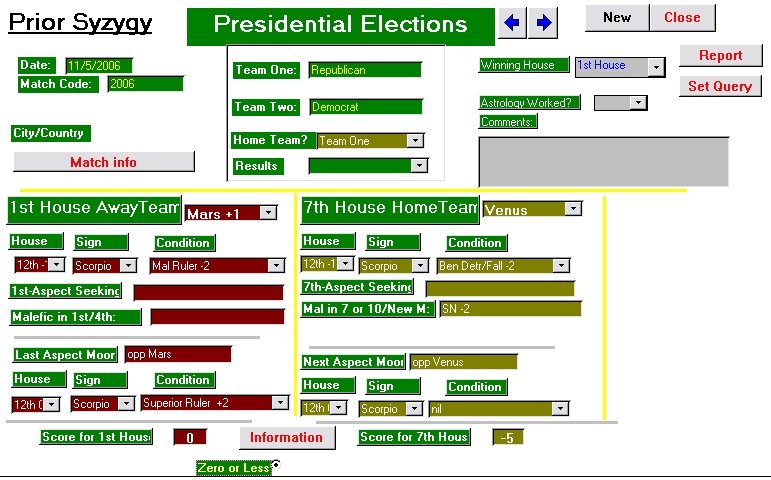
Those of you who have followed my presidential party prediction model will recall that which syzygy: i.e., whether the prior lunation is a full or new moon, may be a predictive factor. So it made sense to examine it here as well.

In the one-term group, there's no difference in which syzygy preceeds the inauguration, whereas the two-term presidencies have a preponderance of full moons. 2009 is a full moon, which means it's not predictive.


9. Retrograde Planets

It made sense to examine whether there was a difference in the distribution of retrograde planets between the two groups.

You will observe on the last two graphs that I have also inserted a category for "died in/left office." And it will be readily apparent on this graph that retrograde placements seem overly abundant in the "died in/left office" category: at least for Jupiter and Mercury. There do seem to be some differences in the distributions between one-term and two-term, but not regarding this year's retrograde planets: Mercury and Saturn. However, as we have just observed, Mercury retrograde is pretty common in the inaugurations of those who died or left office: Mercury retrograde appears 44% of the time in these charts.


10. The Quadruplicity of the Moon

It is extremely common in horary to read relative timing off the quadruplicity of significant points in the chart. And what can be more significant than the Moon? Here are the results.


In the one-term presidencies, a cardinal Moon is most common; in a two-term one, a mutable Moon is. It's interesting that this is the pairing: cardinal for short-term makes sense, but mutable (or common as it used to be called) implied that two-terms is "common" or average - which it is not. Oh well. In 2009, the inauguration Moon is at 29 Scorpio. As fixed works out to be about the average point for one-term, whereas it is less than average in two-terms, I rate this an argument of a one-term presidency. And fixed is uncommon in died/left office, so this is another argument against that scenario.


So I got this far, with one-term leading two terms by 4-2. But I wasn't happy. One major factor is that 33 elections is not really that many, and unlike my party prediction model, I don't really have a track record for using the sum of these factors to correctly predict and outcome. So I decided to examine more factors.

11. The Quadruplicity of the Ascendant Ruler

Because the the noon charts erected for either March 4th or January 20th, there have only been two Ascendant rulers: Moon or Venus.


This one has a really distinct distribution: and one so extreme, that it's really compelling. Clearly, when the ruler of the Ascendant is mutable, there's a high likelihood of two terms, whereas cardinal and fixed look like one-term. The fact that this is so extreme is very important, because, most likely, some of these factors are not really that predictive. But this one looks like it could stand up. In 2009, the Ruler of the Ascendant is Venus in Pisces: so this calls a two-term presidency. As I said, this made me sit up and take notice!


11. The Quadruplicity of the Midheaven Ruler

If the Ruler of the Ascendant is significant, then why not the MC, as the MC is the king in the old mundane systems?

Frankly, the distributions here don't suggest much of anything, because, in all cases, cardinal leads the pack. In 2009, the MC ruler is Saturn in Virgo: mutable. By the way, the two MC rulers that have happened historically are Jupiter and Saturn.


12. The Quadruplicity of the Part of Fortune

Again, this is not a particularly compelling distribution. One term presidencies are more likely to have the Part of Fortune in a fixed sign. In 2009, the Part of Fortune is in Pisces, so this one doesn't matter anyway this year.


13. The Quadruplicity of the Part of Fortune Ruler

To understand what to do with this graph, remember that there have been twice as many one-term presidencies as two. So when I tell you that in 2009, Jupiter is Aquarius, what we do to compare the graphs is to take the frequency of fixed in the tw-term presidencies and double it - this produces 8. This is taking the 11 two-terms and normalizing them to the 22 one-terms. Now we compare 10 to 8: and the difference is not that big. No call here.


14. The Quadruplicity of the Ruler of the Moon

What is immediately obvious with this graph is that one-term presidencies generally don't have the dispositor of the Moon in a mutable sign. As for the other quadruplicities, the effect is not that great. In comparing 22 one-term presidencies to 11 two-term, the number of two-term occurrences needs to be doubled to be of comparable size. In 2009, the Moon is in a cardinal sign. So: the cardinal number for this comparison is 6 (3 times 2), compared to 9 for the one-term: so a cardinal dispositor favors a one-term presidency.


15. Which Planet is the dispositor of the Moon

In doing the quadruplicity of the Moon's ruler, I noticed that among the two-term presidencies, Jupiter seemed to be the most common dispositor. So I decided to break this out by planet. Here your see the three distributions top to bottom: one-term, two-term, died/left office, with the planets in the Chaldean order, starting with the Moon itself.

The one-term presidencies favor Saturn as the Moon's dispositor more, while the two-term ones favor Jupiter. As the dispositor of the Moon in Scorpio in 2009 is Mars, there is no prediction from this factor this time.


So here we have it: ten factors which show a different distribution between these different presidential groupings. Of those which are predictive in the case of 2009, there are five arguments in favor of a one-term presidency, and three in favor of a two-term presidency. So my prediction based on these factors is for a one-term presidency. But I am really struck by the opposite prediction using the quadruplicity of the Ruler of the Ascendant.

What I have presented is the beginning of a model. Frankly, I would like to have a lot more factors.

One final note. Both my prediction here, and my prediction of the election itself, are based on mundane factors only. In other words, both these models imply that there is a current at work at the time of each election, and that the people who step into these roles of candidate or president do not contribute to the outcome: the die is already cast. Now, I have to say that I don't entirely believe that. If Barack Obama wins (and it would certainly be my personal preference), then one way of expressing this would be that his personal chart contains one or more configurations which allow him to rise above the mundane stream. Perhaps that's the next interesting study: what marks an individual to beat the odds? Both these mundane models very much imply that there is a script - and that oftentimes, the candidate simply reads the scripted lines, and the play moves effortlessly to Act IV. But not always. So what is this spark? At the moment, we don't know - but it certainly is an interesting question.

Sunday, September 07, 2008

Sarah Palin and Pluto in Late Sagittarius

Many of you may know that I predicted that John McCain would win this election (you can see a "summary" of the prediction on YouTube (http://uk.youtube.com/user/leephd53). While my model is quantitative, I thought that there would likely be some last religious fundamentalist as Pluto retrograded back into Sag. I guess we have found it in Sarah Palin's nomination. While I have to admit that there is a certain entertainment value to conservative Republicans learning how to say "sexism" in a complete sentence, there is also the challenge - is a Pro-Life feminist really a feminist? My gut is to say "free speech," but what about her whole package of beliefs? For a somewhat different historical approach, you might like to read Sommer's article at http://www.aei.org/publications/filter.all,pubID.28410/pub_detail.asp. Is Palin then just a repackaging of conservative feminism?

The rest of my thought about Pluto in late Sag for the election, followed by the ingress into Cap just afterwards, is that whoever is elected will be elected under one premise, and have to govern under another.

Sunday, January 20, 2008

Two Books on the Culture of Medieval Islam

Griffith, Sidney H. The Church in the Shadow of the Mosque: Christians and Muslims in the World of Islam (Jews, Christians, and Muslims from the Ancient to the Modern World). Princeton, NJ: Princeton University Press, 2007.


Gutas, Dimitri. Greek Thought, Arabic Culture : The Graeco-Arabic Translation Movement in Baghdad and Early Abbasid Society (2nd-4th/8th-10th Centuries). London ; New York: Routledge, 1998.


I believe that, if the astrological community is to be viewed seriously on the outside, it has to collectively learn how to behave critically. This means thinking about thinking, among other things. And this means that we have to learn how to critically examine our own authors. Which is a short-hand way of saying that what we should not be doing is praising those works which “agree” with our personal viewpoints, while dismissing or trashing those that don't.


Until we can achieve this level of understanding, we look like a cluster of Christian heresies from the 4th or 5th century CE, each lovingly transmitting its own opinion of the nature of Christ and God, while condemning all other beliefs to Hell and damnation.


As an exercise in presenting this idea of the critical approach, I'd like to contrast two books that cover roughly the same historical period: one of interest to astrologers, as you will shortly see.


The period of the Abbasid Dynasty (750-1258) marked the consolidation of Islamic power after the first political dynasty, the Umayyads, who had ruled since the Prophet's death. The first century and one half of the Abbasid period included the great period of translation of Hellenistic material into Arabic from Syriac, and then Greek. This material included virtually the entire corpus of Hellenistic astrology, as well as massive quantities of other Greek natural philosophy and medicine. This translation movement then sparked a highly creative and productive period of commentary, as Arabic-speaking philosophers (Muslim, Christian and Jewish, as well as some remnant Zoroastrians) digested the material, commented upon it, and then developed new ideas of their own. This period also significantly opened up transmission of Indian ideas to the West, as Muslims increasingly became involved in the wars and politics of the Indian subcontinent. From an astrological standpoint, the Abbasid period marks the transition from The Hellenistic and Sassanian forms of astrology into what is first called Arabic astrology, then Medieval astrology, the latter especially as the Arabic works in turn are translated into Latin primarily in Spain and Italy, especially from the time of the 12th century.


Gutas' work has taken barely ten years to become a classic. I am not saying this because I “like” it, but because it has become an extremely influential work to historians of this period. This means that any subsequent work about this period would be considered suspect if it did not refer to Gutas' work. I should add that Gutas covers the translation of astrological works quite overtly. As is typical of the period (of historians of science) , Gutas does not attempt to minimize the role of astrology in the society and natural philosophy of the time, although neither does he discuss the content of the works in the way that a practitioner would.


One of the things which is so intriguing about this particular time and place is that Muslims, Christians and Jews were able to work together so cooperatively. While politically, there was no question the Muslims were at the top of the heap, their fellow Monotheists were able to contribute substantially to the intellectual life of their shared culture.


Having said this, what is also intriguing is that the Muslim political policies made conversion to Islam desirable – but not compulsory. This was way more of a carrot approach than the stick employed by the Christian monarchs Ferdinand and Isabella and their successors in Spain. The net result is that, from the time of the Umayyad conquests through the next five centuries, the Muslims went from being a tiny minority in their conquered lands to a huge majority – and largely through the voluntary conversions of individual Christians.


Gutas did not cover that issue within his work: it simply wasn't the subject of his study. It was to address this political dimension that I wanted to read Griffith's book.


The contrast of writing styles could not be more extreme. Gutas has a clear, factual writing style that is easy to follow. By contrast, Griffith' writing is filled with run-on sentences and hyperactive footnotes that seriously mar the readability of the text.


Further, I cannot say I really know that much more about the transition of the Islamic Empire from a numerically Christian-dominated zone to a Muslim one. Griffith's major development is to emphasize the development of apologetic writing – an odd name to someone outside the field, but a technical term for the “defense of the faith” writing of the Christian hierarchy to defend the spiritual superiority of Christianity. These writings were meant to discourage conversions to Islam – which we know statistically they failed to do. He does present some evidence that the different Christian sects managed to cobble together an entente of mutual interest – and that is something worth noting. However, I came away from his work still wondering how significant these apologetic writings really were to the intellectual life of the time.


Will Griffith's work become a classic like Gutas'? I seriously doubt it. I think its major flaw – apart from stylistic – is that it actually represents a rather narrow study masquerading as a larger topic. Had the work been clearly labeled as a study of Arabic-language Christian apologies, it would have had the benefit of matching its title. But the implication of a broader river instead of a deeper, but smaller stream, leaves the reader unsatisfied.

Friday, January 18, 2008

The Alethiometer and Horary Astrology

So I admit it – I was quite intrigued by Philip Pullman's His Dark Materials – the books, not the movie. Frankly, I fail to see how any movie version of these books – especially book three – can even begin to do the book justice, because the anti-clerical, anti-Christian tone is simply too dicey for a Hollywood production: unless they grasp the essentially gnostic tone of the story, and understand that the Authority is a stand-in for the Demiurge, and not necessarily any statement on higher reality.


But apart from religious scruples, I was fascinated by the alethiometer. The alethiometer stands in as the perfect form of divination: divination that is the truth, if only one knows how to read it. Further, we note the fascinating change – Lyra can read it perfectly as a child, but at the change to adolescent - which is such a huge factor in this series – strips her native ability. After the change, she must rely on books and a painfully long learning curve to achieve the result that came naturally such a short time before.


What is the lesson here? I think it may actually be the same lesson as why each individual's daemon assumes one single form upon entering adolescence: the truth that the alethiometer reads is parallel to the truth one sees about oneself.


To children, adults are arbitrary beings doing arbitrary things. Adults are, so to speak, forces of nature. Meanwhile, children are beings in the process of becoming. Adolescence and early adulthood is the time that a child becomes “fixed” into an adult. And it is in the period of early through middle adulthood that the personality is the most fixed. And here in lies the key to the alethiometer.


Lyra's questions to the alethiometer either ask about what has already happened – or what will happen. In this sense, the questions she asks (and the others ask other alethiometers) are exactly analogous to those horary questions I encounter daily. Divination is about what you don't know – and you may not know about it even though it has already occurred – or because it hasn't occurred yet. The past you don't know is exactly like the future that you cannot know.


But there's the machine – and then there's the diviner, or reader. As a child, Lyra is free to associate symbols, and intuit the meaning. And she obviously has a talent for this: that's what makes her so special. With maturation come passions – passions unlike anything she experienced before. Emotions become complex. And in that complexity, she loses this native ability, just as Pantalaimon loses his ability to change shapes. And I believe this happens to the daemons not because they cannot change, but because their humans cannot bear the fluidity of change.


It is into this universe of fixed personalities that adults learn to read the alethiometer using books and fixed methods. It is described as a lifelong process. In teaching many students horary astrology, I am struck by how hard it is for many to creatively break the rules. It's an odd universe, the process of divination – one is constantly confronted by the curious juxtaposition of needing to have a really good rule book – but the also the ability to know when to transcend those rules. It was this conundrum that I attempted to address when I titled my book The Martial Art of Horary Astrology – because, like the good horary astrologer, the good martial artist has to practice the rules until they are absolutely instinctive, because only then will one be able to know when to ignore them. Slavish following of the rules produces a fighter who is completely predictable, or a pedestrian interpretation.


Curiously, this flat-footedness seems to most be a part of early to middle adulthood. One is too caught in trying to look good, and so one over-asserts oneself and one's ego into everything. It is only as one gets older that one truly begins to see the commonalities within the fierce assertion of individuality – and then one's interpretation becomes more fluid.


So if it takes a lifetime to “learn” the alethiometer, is it because it takes a lifetime to break down the mask that one so carefully builds up? What does that say for the mask that fractured that “childish” native talent in the first place? And what does this say for prediction in general? It has been my contention that horary operates in the reality that, while we always have free will, it's simply easier to not exercise it. It's always easier to do what comes "naturally" than to have to consciously think about alternatives. I would suggest that therefore horary - or the alethiometer - works best for young to middle-aged adults. Because that represents the life-phase where the armor is hardest - and I don't mean armored bear here! As to older adults, the question is really whether that person is clinging tenaciously to the armor, or accepting its inevitable dissolution.

Tuesday, July 24, 2007

Harry Potter from a Feminist Perspective

Yes, I admit it. My partner and I took turns reading Harry Potter and the Deathly Hallows aloud to each other the weekend of its release. It seemed both fairer, not to mention more fun, to savor that last piece of the story together.

I do not propose to justify my particular interests from a feminist perspective: frankly, I’m long past that dubious exercise. What I would like to address is the Harry Potter phenomenon, and what it can tell us about the status of women in the 90’s and ‘00’s, when these Books were written, and in which they are also set.

J.K. Rowling – Jo to her fans – is said to be the wealthiest novelist ever from this series, having grossed over $1 billion in royalties. Almost as much as the Books themselves, part of this story is also the story of Jo and her fans – and how she has set the agenda for the discussion and review
of these Books in a post-Internet world, a highly instructive process by itself.

So let’s lay the groundwork. The Harry heptology is the blockbuster fantasy series of our time, supplanting the Lord of the Rings (LotR ) series for this crown, despite the stunning Peter Jackson movie renditions of the Ring Trilogy. Thus, it is worthwhile to compare elements of both. Both series drew upon rich sources of Western mythology to create vivid and varied worlds. Magic is a hallmark of these fantasy worlds, like so much of the fantasy genre which LotR could be said to have seeded. Within different fantasy universes, magic works differently. In LotR, magic is a specific province of particular races, like the Elves (Elder). Magical objects – most notably the rings – can achieve a kind of sentience: a plot mover in LotR is the desire of the One Ring to return to its master, and its ability to actually make events happen that will move toward this goal.

Magic in the Potter (HP) series is congenital: one is born either magical or muggle, with magical ability usually manifested by the age of seven, and with non-magical offspring (squibs) possible within magical families, and magical offspring possible within muggle families. In this, Rowling’s universe more closely resembles psi ability in the sci-fi television series Babylon 5, although it could also be said that both of the latter series are reflecting the post 1950’s scientific outlook of DNA and genetics.

Two of the great religious-philosophical issues are shared by the two fantasy series: Fate, and the problem of Evil. In LotR, evil is incarnate in Sauron, the current Dark Lord, who was lieutenant to the previous Dark Lord of an earlier age. Sauron crafts a ring of power – the One Ring which will rule over all the magical rings of Middle Earth. In the Potter series, the Dark Arts can be studied by any magician, and in the modern period in which the Potter series takes place, a dark-magical expert named Lord Voldemort emerges. HP is the story of the entwined fates of Harry Potter and Lord Voldemort. When Harry was one year old, Voldemort murdered his parents, and then attempted to murder Harry. Instead, when he tried, the killing curse rebounded on Voldemort, disembodying him, while Harry was left with a lightning-shaped scar. Harry was henceforth called, The Boy Who Lived, because nobody previously had ever survived a killing curse. Evil is a bit more relativistic in Harry Potter: one becomes evil by doing evil deeds.

As for Fate, the Fate of LotR is multi-layered and inter-generational. It is clearest in the character of Aragorn: the descendant of King Isuldur, who defeated Sauron and then failed to destroy Sauron’s ring, thereby allowing Sauron to eventually return to power. It is Aragorn’s job to fix the mess, if the new age of men is ever to dawn.

In HP, Fate is personal: the whole series of events leading to Harry’s parents’ murders and Harry’s survival sets him up as the Chosen One – the one who ultimately must go toe-to-toe with Lord Voldemort for the hearts and minds, bodies and souls of the wizarding community.

Before we proceed to an actual examination of the works, it’s worth mentioning one biographical note: J.R.R. Tolkien originally invented Middle Earth and the stories to engage and amuse his children: the effort of an extremely bright academic philologist to engage his sons in his own academic passions. J.R. Rowling wrote her Books to support her child: she completed the first volume as an unemployed divorced mother, a few years after the death of her own mother.

At first, it’s easy to critique the HP series from a feminist perspective (and it has been done) – the current Top Dogs are all male: Voldemort, Harry, Professor Dumbledore, and the various Ministers of Magic. There is the slightly disturbing piece that all female magicians are called witches, while all male magicians are called wizards. To most ears, “wizard” sounds better (perhaps because of Gandalf in LotR) – had Rowling chosen the word “warlock” for the men, the footing would, perhaps, have felt a little more equal, although still raising the question of why the genders need to have different words ascribed to them at all. It is, by the way, completely appropriate to critique Jo on word usage: she has shown great care in her choice of language over the years, and especially in choosing titles for foreign language editions. Further superficial feminist critiques include the level of giggling among the girls, and the housewife roles like Molly Weasley. On the other hand, having taught girls of this age: I'm sorry - but they giggle. This may not be a convenient feminist idea, but it is true!

But I think these issues are better considered comparatively. LotR was written roughly fifty years before HP. In LotR, the female roles are ancillary and cardboard, for the most part. Of course! Tolkien invented this world for his sons, and so males occupy better than 95% of the roles, except for extras, of course. They mostly move the plot passively, if they move it at all. Some, like Goldberry, are female Earth or Water deities. Galadriel is the one female Elf ring-bearer (there are no female ringbearers among either the dwarves or men): and she uses her ring to maintain the forest Lothlorien, and to prophesy. Arwen is Aragorn’s love interest, an Elf, who gives up immortality to be with the (mortal) man she loves – a part so sketchy in the book that Peter Jackson considerably juiced up the role in the movie. The only active part is Eowyn, of the royal house of Rohan. She sneaks along with the army that rides to fight in Gondor, and acts as the agent to kill the leader of the ringwraiths – a man for whom it had been prophesied that no man could kill him. She thus acts the part of demonstrating, as was so typical of the Celtic concept of prophesy, that the exact wording of the prophesy is critical.

Things are much different in HP. Here, the first notable point is that the Trio as they have been dubbed – Harry, Hermione and Ron – is two boys and a girl. Stop and think about this – this is actually exceptional. How many trios do any of us remember growing up that were mixed gender, unless they consisted of brothers and sisters? Jo has said that Hermione was a composite of herself and her sister – Hermione played the role of the smart kid who kept Harry and Ron in passing grades in many of their classes – and was always there to do the library work to figure those things out that they needed, but hadn’t been taught yet. Because she read so much, she found amazingly useful spells that the boys couldn’t even begin to consider. She learned how to make complex potions and sophisticated spells by reading about them and then trying them out.

Women are all over Hogwarts, even if they aren’t in charge. Professor McGonagall is the Deputy headmistress throughout six of the Books, briefly becoming Acting Headmistress at the end of Book 6. Other regular female professors are Professors Sprout, Trelawney, Hooch, Vector and Sinistra. This works out to a staff gender ratio of 1:1. As far as we can see, the gender ratio of students is around 1:1. The school was founded by two witches and two wizards. The four houses that they produced are still headed by faculty members in a gender ratio of 1:1.

The issue of career pathways and choices for women seems to be open. It appears that Molly Weasley chose to be a housewife: but she also chose to be a member of the Order of the Phoenix, a resistance group set up by Dumbledore the first time Voldemort attempted to come to power. There are many witches employed at the Ministry of Magic. Witches are textbook authors, judges and examination supervisors. The professors at Hogwarts seem to follow the Medieval model of being in Church orders, which meant celibate. But whether this was compulsory is never stated. And here is one of the areas where the magical community does seem to differ from the muggle community: it appears that there may be a lower incidence of marriage. And what does seem to be completely absent from the books is any hint of homosexuality.

The story takes place in the United Kingdom in the 1990’s. The magical community is a parallel community to the muggle one: as such, it is going to look a lot like the world as a whole. Would a sub-community with no sexism and racism even be believable to kids (much less adults) reading what to them is contemporary fiction? I think not. In fact, it is precisely Jo’s brilliance at portraying Harry as the totally realistic obnoxious self-centered adolescent in Book 5 that sets up so much of the plot development in Books 6 and 7. Voldemort’s vicious sexism in Book 2 causes him to completely discount Ginny’s emerging strength – which becomes an increasingly important plot element as the series proceeds. Hermione’s bookish personality may not look like heroism in Book 1, but she does show an innate ability to think on her feet, and she finds her courage totally by Book 7, when she is in the thick of the hunt for and destruction of the horcruxes.

As it is, Jo’s magical community is less sexist – and racism becomes a major issue in the books: often, but not always, intertwined with evil. Racism in the magical community is shown in two ways: the ancient preference of some of the wizarding families for pure blood (i.e., no muggle ancestry, or at least none closer than great grandparents), and the treatment of the other sentient magical species: goblins, centaurs, and house elves. In Books 5 and 7, the racist oppression of others by the evil side is a primary theme. In Book 7, the benign neglect type of racism of a character counted among the “good guys” in Book 5 is shown to have been partially responsible for his death, and Harry himself gets involved with “fixing” things with the aggrieved party.

In comparing HP to LotR, we see not only a massive increase in both the number and complexity of female roles, but we see a greater articulation of the concept of evil. Tolkien did the written version of LotR in the shadow of World War II: when the whole Nazi regime could be seen as a personification of evil. Tolkien wrote of the ring of power: that the power over others was the gateway to evil deeds. Compare the evil of Sauron to the good of the Elves: the three elven rings were used to protect the people and lands. But in Sauron’s obsession to amass all power to himself, he insured that the other rings could not defeat him – but this also insured that when his ring was destroyed, that destruction in turn destroyed the power of the elven rings.

In HP, the track which turns Tom Riddle from a somewhat sadistic boy into a true bastion of evil as Lord Voldemort was his obsession with conquering death: and then surrounding himself with a cadre of Death-Eaters for whom the purity of (magical) blood was a paramount issue – this, despite the irony that Riddle/Voldemort himself was a half-blood (i.e., half muggle). In Book 7, it is also revealed that the last great evil wizard was also obsessed with the need for power over the muggle community. Riddle is gradually revealed through Book 6 to have been a loner – a boy/man who felt no familial connection, and no true friendship. As Dumbledore prepares Harry for the Final Showdown, he emphasizes to Harry how Voldemort cannot begin to understand the love and sacrifice of Harry’s mother when she allowed Voldemort to kill her, but as her last act, wove a spell around Harry which deflected Voldemort’s killing curse back upon himself. The theme of power vs. love resonates to an old mythos in the human psyche.

It should further be emphasized that Rowling does not merely populate the Good side with women: they are among the most evil characters as well. Voldemort has followed Hitler in designing the "chain of command" as a diffuse structure, not a tight hierarchy. That way, nobody but him knows everything going on. But within the competition thereby created for his attention, one of Voldemort’s top lieutenants is Bellatrix Lestrange, who of all the Death-Eaters, appears to be the most bloodthirsty by far. But witness her duel with Molly Weasley in Book 7 for two sides of the coin. Molly fights not out of malice, but for her family and friends: her two brothers had been killed in the earlier confrontation with the Death Eaters in Voldemort's first rise to power, and she has been suffering from the losses to the Order of the Phoenix in this more recent war as well.

The other seriously evil female character is Dolores Umbridge, who is a Ministry of Magic plant brought in as a professor in Book 5 to keep an eye on Dumbledore, when the Ministry of Magic suspects Dumbledore of lying about the return of Voldemort at the end of Book 4. Although not a Death-Eater (i.e., follower of Voldemort), she has a completely sympathetic vision of the future of the magical community (pure-bred), and some sadistic ways of enforcing her will, whether on students (Book 5), or on the magical community itself (Book 7).

I would be as seriously suspicious of a tale this complex with no evil women as one where all the evil characters were women. Thus, neither good nor evil is presented as having a gender affiliation.

In judging the whole of the work, it needs to be remembered that this was, from the beginning, a commercial enterprise on Rowling’s part. There is no shame in an author who wants to support herself on her writings! Part of what has made this such a successful work is that there is close to a perfect mix of creative imagination with realistic character development. Pretty much everybody can find at least one character to identify with – apart from the sexual preference omission. Rowling leads a bit on gender equality and certainly more than a bit on racism. And one has to acknowledge that the question of just how far one’s fiction should lead ahead of contemporary mores is as much a tactical one as anything else.

Note: I wrote the above before Rowling "outed" Dumbledore, which raises a whole series of other questions. Was Jo right to exclude any mention of homosexuality from the actual text, and then bring in the topic later? I have heard two sides to this question. On the one hand, and this seems to be the larger faction among feminists I have spoken to, is can be viewed as cheating. While there was nothing in Dumbledore's background to suggest that he wasn't gay, it was a bit of a stretch - but not impossible - to piece together the story of Grindelwald and the impact of Dumbledore's personal/sexual feelings on his subsequent behavior. However, this level of reading into the plot hearkens back to a much earlier period in gay history: the "Before Stonewall" Era, when only a hint of deviance was kosher. In that time, legions of lesbian and gay readers followed Jeannette Foster's example in Sex Deviant Women in Literature in teasing out the slightest nuance which could suggest this possibility. The fact is: in roughly forty years time, most of us have lost this knack - if we ever had it.

The other point of view is that Jo did the right thing: these works are, after all, technically children's literature, and perhaps it's best to just leave the whole thing out. I have to say I would disagree with that viewpoint: I am reminded of Philip Pullman's comment en passant about a minor character in The Golden Compass that he was unusual in having a daemon of the same gender that he was - a comment alive with possibilities, and yet hardly explicit in any way.

Of course, in Rowling's case, we may find that she has her cake and eats it too. By "outing" Dumbledore during the filming of Book 6 - where we first glimpse the younger Dumbledore - and before Book 7, one would ask how these scenes will be handled now.

Thursday, November 30, 2006

An Open Letter to Maria K. Simms

Congratulations on the release of The New American Atlas for the 21st Century – Michelsen Memorial Edition (http://www.starcraftseast.com/). It’s hard for me to believe it’s sixteen years since Neil’s death. Our own paths diverged only a couple of years after Neil’s death, as first you, and then I left the NCGR Board, the place where we had briefly walked together.

Neils’ early death so easily could have been much more of a tragedy, but for you, who chose to assume the mantle of keeper of the flame. This new edition shows that you have done so with grace and discernment. This could have just been a slavish reproduction with a new cover. But no: you and Rique Pottenger chose to update it, making the best current calculations available based on equations that Neil didn’t have. Then, in what was the first choice of an astrological ephemeris publisher since the astronomical flak last Summer about the planetary status of Pluto, instead of demoting Pluto to a monthly position, you took the bold stroke of adding Ceres to the main pages while retaining Pluto. What more fitting tribute could there have been to Rique’s mother, Zip Dobyns, who also makes a cameo appearance in the section remembering Neil.

So kudos on the publication!

Saturday, October 28, 2006

2006 Elections

The reason that I don't often make predictions about post-season baseball is that I'm too passionate about it. Strong emotions interfere with good predictions. Which is why most astrologers find themselves to be somewhat flummoxed with their own charts. The other area where strong emotion frequently gets in the way is politics: where almost everybody seems to have an opinion as strong or stronger than the most rabid sports fan pulling for his/her favorite team.


And so again: it's election season.


Well over a decade ago, I worked with Bernadette Brady to build a quantitative model for doing sports prediction based on the Medieval astrologer Guido Bonatti's rules of warfare. With this model, we were able to beat bookmaker's odds for both the cricket matches known as the Ashes (in Bernadette's case) and US football Superbowls in mine.


Shortly thereafter, I asked whether these models could be similarly applied to presidential elections. I did a study not only to determine if the warfare model in general worked (it did), but also which chart to use for the presidential election, as so many mundane possibilities existed. The three charts which historically produced the best results were:


  • Midnight election day

  • The prior lunation

  • The prior Libra Ingress (a contrarian model: i.e., it predicts in reverse)


Note: this article can be found at my web site under http://www.leelehman.com/downloads___references.html


Although this model was developed specifically for presidential elections, I have experimented in the past with applying it to presidential off-year elections. In this case, my hypothesis is that the same model that predicts the presidential result by party could predict whether the congressional elections show a net gain or loss for the party in power.


Therefore, in the spirit of this hypothesis, I present the predictions for 2006.


Here are the tabulations according to this model for the three different charts. Please click on any of the graphics to see a larger view.


The only chart here which may be unclear is the Libra Ingress, since the score is tied. The rule for tie-breaking is that the superior planet “wins;” thus all three models favor the Democrats. The conclusion is that the Democrats will gain seats: how much is not a function of the model.


Tuesday, August 01, 2006

Can Accountants be Astrologers?+

In the wake of Enron and other such messes, I want to ask this philosophical question. Granted, greed is endemic to the human race. Kenneth Lay’s excesses along with those of his cronies are merely one chapter in a long history of corporate-government corruption that includes such earlier chapters as Tammany Hall, Exxon Valdez, countless scandals and bubbles, and schemes.

So why get upset about Enron, apart from its environmental consequences, and its obvious tie-ins to the Bush Administration, and the Clinton one as well? The reason, I think, relates to the legacy of the Reagan Administration in the USA, and Thatcher in the UK. There was a fundamental paradigm shift then that still relates to life today. To follow the very interesting presidential study of historian Stephen Skowronek, particular administrations set up a paradigm of government that holds until the next paradigm.* Subsequent administrations either follow the lead of the paradigm-setting administration, or unsuccessfully react to it, until the whole thing collapses with the new paradigm. In Skowronek’s model, the Reagan Administration was the last paradigm, with F.D. Roosevelt before that.

Curiously, one of the accomplishments of the Reagan Era was to further complete the secularization of society which was a hallmark of the Enlightenment – the furtherance of the very point of view that banned astrology from serious intellectual consideration. And even more curiously, that secularization is currently being driven in part by a group of Christian Fundamentalist businesspeople – whose own beliefs are also ultimately compromised by the same position they are advocating.

Whether one chooses to blame Reagan’s economic team, or the simultaneous influx of data processing into business, the fact is that the way that business is conducted on the inside changed radically in the 1980’s. The advent of relatively easy access to reams of data not merely allowed, but virtually mandated that all larger businesses run everything “by the numbers.” The Walmart model of breaking down every sale into components of line item and customer zip code preferences heralded the era of “ship on demand” and frequent buyer clubs: where the clubs were “sold” to the public as benefiting them, but where the real beneficiaries were the companies.

The dark side of this force is that everything and everyone became a number, or merely an aggregate of numbers. And this is where everything changed. Customers became numbers. In the airline industry, this resulted in smaller seats, less legroom, horrible and eventually either non-existent meals or purchased meals as airlines raced each other to find every last way to shave a little bit off the cost,or raise the price a little bit. Flying became uncomfortable as customers were forced to the realization that these literally are cattle cars, and the airlines blamed 9-11. Flight attendants have told me that once their payroll was automated, they routinely found errors in their paychecks – and these errors were always in the airline’s favor.

This disconnection between money and humanity – the severance of any sense of humanity in a business transaction – means that customers can be constantly hit with questionable charges, support centers can be outsourced in ways that significantly impact customer relations, and employees are reduced to productivity machines. The irony is that in the immediate decades leading up to this sea change, there was substantial research suggesting the models such as Abraham Maslow’s where employees are treated well, and allowed to make a significant contribution to self-autonomy, do in fact increase productivity. Whereas treating people as numbers and reducing choice results in lower productivity in employees, and loss of brand loyalty in consumers.

Yet, these newer quantitative models persist, presumably because the short term numerical analysis looks good on paper, and because numbers often provide a comfort blanket, regardless of whether they are correct or meaningful. What these models lack is any accounting for the uniqueness of individuals, or any incentive for service beyond the mediocre. Ironically, the enforcement of these quantitative systems has encouraged workers to act exactly like workers under the Communist system that supposedly was debunked: work is rewarded equally whether one does a good job, or a poor job, so why excel? These methods demean the individual person, declaring the only good to be “value,” which is strictly quantitative.

Whether one is interested in examining life astrologically or spiritually, this approach is both disastrous and demeaning. These systems declare the value of the individual so strongly that they are meaningless without it. You cannot run your life astrologically based on my chart – or vice versa. You cannot rely on me to do your spiritual work – or vice versa. We know that the whole is not the sum of the parts. Whenever we ignore this, we encourage those who seek to tear down our beliefs. Never forget this!

For a really interesting website related to this logical issue of the whole not being the sum of the parts, see http://www.abelard.org/category/category.htm.


+ With thanks to Nick Campion, who asked a question which provoked this essay.
* Skowronek, Stephen. 1997. The Politics Presidents Make: Leadership from John Adams to Bill Clinton. Belknap Press: Cambridge, MA.

Sunday, July 23, 2006

The Thirteenth Sign? What to do with Ophiucus

When I was first coming up in astrology oh so many years ago, there was a book called Arachne Rising, proposing a 13th sign. Now, the discussion is about Ophiuchus. Now, Ophiuchus is technically on the ecliptic. But I think what we may need to realize is that this is not a new phenomenon.

What is different now is that some very slick anti-astrology skepticism is picking up on this as an argument against astrology, as you can see through sites like: http://www.griffithobs.org/SkyOphiuchus.html. On the one hand, this website is completely correct. But that same page actually mentions part of why this issue is being raised now, and it has nothing to do with astrology. In the 20th century, it was the astronomers who redrew all the constellational boundaries so that all of the sky is defined. In other words, you have a fundamental re-definition of what a constellation is. The traditional idea was that a constellation like Cancer or Virgo was a recognizable group of stars that looked like something, and therefore meant something. Constellations were seen as being discrete: in other words, there was "space" around them. When astronomy seriously separated from astrology in the late 17th century, it maintained the old definition of constellation, while stripping it of astrological meaning.

Then, astronomy, in going its separate way, engaged in massive study of the sky with vastly superior telescopes. The more they looked, the more objects they found: more stars, and ultimately, galaxies, nebulae, clusters, etc. Under the telescope, the sky ceased to look like a series of discrete pictures, and by the 20th c., astronomers had realized that the constellations themselves were not "connected" in any way: the pictures only look that way from Earth, because the stars of a constellation aren't necessarily "near" each other in three dimensional space.

Thus, astronomy needed a system for ascribing location, and that meant that they needed to cover the entire celestial sphere, not just the ecliptic. Within this quest for locational accuracy, they redefined the constellations as zones of the sky: yet further divorced from the original pictures of our ancestors.

Then, in the ultimate irony, they come back and chide astrologers for not adapting their changed coordinate system, a system that might as well call a location in Leo as A-150X16 as anything else!

So: back to Ophiuchus. Is there any meaning to having the Sun in Ophiuchus? Maybe. The astrologer who I think knows the most about fixed stars right now is Diana K. Rosenberg. Diana for years has talked about the overlays of the tropical, sidereal and fixed stars. She's also talked about the fact that, using the traditional system, any ecliptic degree actually represents an overlap of several constellations. The fixed stars have always been seen as factors that should be considered in the delineation.

As to whether one should change the zodiac, I would be very reluctant to muck with this when the driving force is coming from a group profoundly hostile to astrology. But apart from that, if the ancients knew there were other constellations which intersected the zodiac, why didn't they incorporate them? Largely, we don't know. There's no historical evidence on this. We've got no one to ask. Whether it's because Ophiucus-Serpentarius (it's really a dual constellation) is simply so large, and that only a small portion intersects the ecliptic, who knows? We can certainly can and should modify our delineations for planets in that region based on the constellational overlap. But junk the old system because 20th century astronomers re-invented the wheel? I don’t think so!

Wednesday, July 12, 2006

Encyclopedia Entry on Horary Astrology

Horary Astrology


© 2002 J. Lee Lehman, Ph.D.

This was submitted to and published in Lewis, James R. 2003. The Astrology Book. Visible Ink: Detroit.

Horary astrology is one of three branches of the general category of interrogatory astrology, literally, the astrology of questions. The other two branches are electional and event interpretation.

Horary astrology requires a Question to be posed by a Querent: and the simpler and clearer the Question, the better. The purpose of horary method is then to provide a means to answer the Question.

As a technology for answering a specific question using astrological methods, horary can also be considered a type of divination. As such, it is akin to I-Ching, Tarot, geomancy, and a host of other divinatory practices.1

The horary process can, for simplicity’s sake, be divided into three components:2


  • Defining and asking the Question

  • Describing the circumstances surrounding the Question – which is to say, proving the Question

  • Providing an answer to the Question.


Defining and asking the Question:

A good horary question is clear, answerable, and can only be asked once. In order to avoid the consequences of asking the same question twice, it is possible to limit a question to a particular time interval. Thus, it is well to encourage your Querent to prefer the wording, “Will I get married within two years (or another time interval)?” to “Will I ever get married?”


Taking the Time

The moment of a horary question is the clock time taken for when the Querent finds it almost impossible to not know the answer any longer.


Noting the Place

Deciding which location to use if the Querent and the astrologer are separated by distance varies depending on the educational lineage of the astrologer. Schools deriving primarily from classical methods favor using the astrologer’s location, while schools deriving from Ivy Goldstein-Jacobson prefer the Querent’s location.


Describing the circumstances surrounding the Question:

By the medieval period, astrologers had begun to notice certain general chart configurations which portended specific answers. These came to be called the considerations against judgment. While it seems that every astrologer had a somewhat different list, the concept is simple: if one of the considerations is present, there is some problem relating to the asking of the question. This is where the astrologer really decides whether the question can and should be answered.

In the 20th Century, it became common to use the considerations as a reason not to answer the Question, but there is no evidence that this was ever done consistently before the modern era. In most cases, the considerations themselves become part of the delineation of the answer.

The main considerations are:

  • The placement of Saturn. If in the 1st House, the Querent may be lying, although misleading may be a better match. In the 7th, the astrologer may not be properly placed to answer this Question unless the Question is itself of a 7th House nature, in which case Saturn simply becomes part of that delineation.3 In the 10th House, the Querent may damage the reputation of the horary astrologer.

  • Ascendant or Moon in the Via Combusta (the zone from 15° Libra to 15° Scorpio. This is considered to be a malefic section of the zodiac. As there have been other degree spans mentioned by the ancient astrologers, it is unclear exactly what the Via is really. It is also not known whether the reference is tropical or sidereal

  • Ascendant too early or too late. An early Ascendant of 3° or less may mean either that it’s too early to ask the Question, or that there is still too much free-will in place to presume to give an answer. A late Ascendant generally 27° or later means that there is nothing that the Querent can do to change the outcome: other plans and events have happened rendering the question moot.

  • Moon Void-of-course. As the Moon traverses a sign it (usually) makes aspects to the sun and other planets. It is as if the Moon still has work to do. After the Moon has completed the last aspect to a planet, its condition is said to be Void-of-Course, vacua cursus. The aspects in use were the five ptolemaic aspects and the bodies, the Sun through Saturn. In classical times, the Moon was not Void-of-Course if occupying four signs: Cancer, Taurus, Sagittarius and Pisces4 (i.e., the Moon’s own sign and exaltation sign, and Jupiter’s two signs). There are multiple interpretations to what this one actually means in practice. The simplest starting point is to be aware that most timing in a horary comes from the Moon: when Void-of-course, there are no events being recorded by the Moon.

  • The Planetary Hour matches the Ascendant Ruler by Triplicity (i.e., their signs are in the same element). The use of planetary hours in modern times has dwindled, but traditionally, these were supposed to match, sharing an affinity between the Question and the Moment.


The traditional purpose of the considerations was to look for red flags that would make judgment difficult.


Providing an answer to the Question:


Generally, the astrologer needs to be able to do the following things to delineate the Question:

  1. Describe the Querent.

  2. Describe the Quesited (that which as asked about)

  3. See if there is any relationship between the two

  4. Provide some detail on how the Querent does or does not attain the desired end


The Querent is always given by the 1st House. The possible Significators for the Querent are:

  • the Ascendant itself

  • the Ascendant Ruler

  • planets in the 1st House, or occasionally

  • the Moon – but this is problematic, because what the Moon really shows in the chart is the sequence of events

A similar list can be drawn up for the Quesited, except that first, we have to decide which (if any) house rules the Quesited.


The Quesited is shown by:

  • the House represented by the nature of the Question

  • the Ruler of that House

  • planets in that house


Table One is a brief listing of house rulerships for various types of questions, done in the classical style.

Table One. Types of Questions by House5


1st House


Longevity, health (disease is 6th), happiness, moving vehicles (planes, trains and automobiles), best period in life, the visiting team in most sporting events.


2nd House


Money, financial instruments directly convertible into cash (bank accounts, CD’s, guaranteed bonds), salary, moveable objects (things you can pick up and carry by yourself), lawyer acting in your behalf in a lawsuit (i.e., barrister).


3rd House


Neighbors, siblings, cousins of the same generation in age, primary education (see below), short trips (see below), religious matters (see below), whether the rumor is true, writing.


4th House


Your father (usually), property (whether land or buildings), hidden or buried treasure, your home, inheritance of land, the home team in many sporting events, gardeners or other workers who do landscaping or other outside work.


5th House


Entertainment, sex (see below), pleasure, gambling, ambassadors (see below), bribery, gifts, the stock market and other riskier investments, alcohol and recreational drugs, children, procreation.


6th House


Pets, disease, accidents (as in: car accidents), employees or day laborers, small animals (i.e., smaller than a sheep, but also includes large but domesticated dogs like St. Bernards), birds, labor unions (the unions themselves, not labor actions).


7th House


Marriage and marriage partners, partnerships of all sorts (business as well as intimate), open enemies, thieves, the other party in a buying and selling transaction, a contract labor or subcontractor situation, the default other person (see below), the other side in a lawsuit or negotiation, the other possibility for the home team in a sporting event, removals (or moving house).


8th House


Death, taxes, wills, insurance, your partner’s money, inheritances other than of property, lawyer representing the other side in a lawsuit.


9th House


Travel, long trips (see below), philosophy, religion (see below), prophetic dreams, lawyers (see below), higher education (see below).


10th House


Your mother (usually), honors and awards, promotions, high managerial jobs, judge in a lawsuit, arbiter in a negotiation, bosses higher up in the corporate ladder, perks given out at the whim of someone higher up.


11th House


Friends, associations, organizations, funding bodies of government agencies, hopes and wishes.


12th House


Witchcraft (see below), hidden enemies, imprisonment, all institutions of confinement, hospitals, self-undoing, large animals (horses, elephants, whales).


Having defined Querent and Quesited, the astrologer has three steps left. First, there may be specific rules that apply to the particular type of question. For example, there are specific rules for determining whether an object is lost or stolen that are considerably more complex than simply determining the house rulership of the object. For more information on this matter, the reader is encouraged to study a specific horary text in detail.


Second, the astrologer needs to decide whether the Question is resolved through perfection or emplacement. A perfection horary requires that some sort of action(s) or event(s) happen in order for the result to be brought about. An emplacement horary relies purely on where the planets are positioned at the time of the horary, not where they will be sometime later. Lost items, missing people or animal horaries, are the emplacement type horaries. Most other horary questions require the significators’ perfection.

The most common perfection is an approaching aspect of the Querent's planet to the planet symbolising the Quesited. Usually, only the ptolemaic aspects (conjunction, sextile, square, trine, and opposition) are allowed, but differing horary systems may include the parallel or quincunx. In a perfection, the faster moving body must catch up to the slower, generally, without the planets changing sign.

Many authors also allow for perfection by mutual reception between the Significators of the Querent and Quesited.

The next most common means of perfection is translation. In translation, a fast-moving body (generally the Moon, but occasionally Venus or Mercury) separates from one of the Significators, and applies to the other one.

There is one very rare means of translation, which is very powerful: collection. Collection occurs when the faster moving body is separating from the slower moving one, but both are applying to yet a slower body. The slowest one then “collects” the other two.

In addition to these means of achieving perfection, there are also other ways to thwart a perfection. These include:

  • Refranation: in this case, the two bodies are moving toward perfection, but before the aspect becomes exact, the faster moving body turns retrograde, and the aspect never happens until after that body goes direct again, if at all in the same sign. This is one of the most frustrating scenarios, because everything appears to be moving in the right direction until things suddenly veer off.

  • Frustration: in this case, again the Significators appear to be moving to perfection, but this time the slower moving planet achieves a partile aspect with a different body before the faster moving body catches up. Again, this scenario shows hope until the person represented by the slower moving Significator goes off in a different direction.

  • Prohibition: the Significators are moving to perfection, but a swifter body intervenes and completes aspects with both bodies first.

  • Besiegement: if a Significator is between two malefics, it is besieged. It is not at all clear how large an orb should be allowed for this. The concept for besieged is: between a rock and a hard place. A besieged planet is not free to act as it is hemmed in on all sides.

If the outcome of the Question is negative, the horary astrologer is finished at this point, If the outcome is positive, then there is one more job: attempting to determine the timing of the events leading to the result, or determining the spatial relationship to the object in question in the case of a lost object.

Timing comes from looking for a degree separation between any of the following:

  • the Significators of the two parties in a simple perfection

  • between the Moon and one of the Significators

  • between a Significator and a nearby house cusp

  • the number of degrees until the Moon changes sign, especially if the Moon is in the late degrees of a sign.

There are actually two scales of time: symbolic, and ephemeris. Symbolic time (a difference of degrees between the two Significators applied to produce time units through the following table) is used most of the time, unless some significant ephemeris event itself may impact the outcome. If, for example, a significant planet is about to go retrograde or direct, it’s common to refer to the actual station date as the critical timing date.

The unit of time to go with this number is given in Table 2.


Table Two. Units of time based on the qualities of the Significators.6

Angular

Succedent

Cadent

Cardinal = days

Cardinal = weeks

Cardinal = months

Mutable = weeks

Mutable = months

Mutable = years

Fixed = months

Fixed = years

Fixed = unknown


Of course, much of the time you get mixed indicators: for example, one Significator will be Cardinal Cadent, while the other is Fixed Succedent. In these cases, you may want to adjust the units of time. The units of time also vary according to the nature of the Question itself.


Direction is not always so obvious, in part because of the frequency of having mixed indicators. The general idea is this: take the major Significators in the chart. Examine their location by sign and by house. If the bulk of the planets are either in one house or one sign, then you can translate this into compass location using the cardinal points of the chart,: the Ascendant as East, etc.


----


Horary was already well developed by the 1st Century C.E. as demonstrated by the work of Dorotheus of Sidon.7 In this remarkable work, Dorotheus presents interrogatory methods for such questions as building or demolishing a building, buying and selling, requesting a gift, marriage, whether a pregnancy will come to term, debt, travel, buying or building a ship, imprisonment, lawsuits, theft, fugitives, illness and bewitchment. While a modern horary astrologer would not likely follow all of his methods, his presentation is quite readable and logical to modern eyes.

The viewpoint that infused Dorotheus was that all forms of interrogations are interpreted with the same methods, except where the type of interrogation forces a change in usage. Furthermore, there is a hierarchy among the three branches, which applies to deciding upon the appropriate time to use for a question. For example, when it comes to theft, if the time of the theft is known, then a chart for the event is drawn. A horary is used only if that time isn’t known. While the differences between reading an event chart and a horary are often not explicitly mentioned, the most important is that in a horary, the Ascendant gives the Querent, while in either event interpretation or electional, the Ascendant gives the event itself.8 Event interpretation is generally for a past event, horary for the present, and electional for the future.

Most likely, horary is much older than the 1st or 2nd Century in which Dorotheus lived. We can conclude this for two reasons: (1) because Dorotheus’ work looks too sophisticated to be a first generation codification, and (2) because Vedic astrology has an absolutely equivalent branch called prashna which is probably equally ancient. At this time, it is impossible -- based on manuscripts and artifacts alone -- to decisively nail down the exact nature of the cross-fertilization of Western and Hindu methods. It is clear that there was extensive sharing of knowledge between the two cultures. We know, for example, that the words used by Vedic astrologers for the planets are transliterations of the Greek planet words. It was easy to postulate that the major source of “sharing” occurred when Alexander the Great invaded Western India in 327-327 bce. However, it now appears that sharing between cultures was far more extensive and over a far greater time period than had been previously thought possible.9

There are several extant katarche (the Greek word for interrogation) from the 5th Century astrologer Palchus.10 Mixed in with questions about taming lions and ships at sea, we see charts drawn for the times of political events: a disastrous crowning of a king, and the time when a Prefect entered Alexandria.

Horary was passed on as one of many techniques when large numbers of Greek manuscripts were translated into Arabic in the period around the 8th Century ce. Because the Islamic expansion extended into India, this was another period of technique sharing between East and West. Dorotheus was one of the authors translated into Arabic, so his methodology became generally known – and influential on subsequent generations of astrologers. Later authors expanded on the Hellenistic authors. William Lilly, the great 17th Century horary astrologer, cited Zael, one of the 9th Century Jewish horary astrologers.11 The 10th Century astrologer al-Biruni (973-1048?) also included horary as part of his work.12

Just as the 8th Century represented a bonanza for Arabic-speaking intellectuals, the 12th Century was the same for Latin-speaking ones, as that marked the watershed for the translation of Arabic materials into Latin. To fully understand the significance of this transmission, we have to be clear about what actually happened to astrology in the Arabic period:

  • Hellenistic (and Persian, which is to say Babylonian) methods were translated into Arabic and studied.

  • Vedic methods were also translated in Arabic.

  • Hellenistic (Western) and Vedic methods could be combined and synthesized.

  • The Arabic-speaking practitioners themselves then added and modified the inheritance that they received.

The influx of material into the Latin West was even more extensive than that experienced by the Arabic scholars four centuries before. Thus, when Guido Bonatti wrote on horary in the 13th Century, the tradition he built upon was already rich.

The Medieval horary astrologer practicing in the West navigated turbulent waters since the very essence of horary astrology – divination – was at best an uncomfortable topic for the Christian Church, and at worst, a mortal sin. Church philosophers postulated that if one can really predict human behavior, then the individual is not “free” to choose Christ and Salvation. While other branches of astrology can adopt the position that the stars incline, but don’t compel, doing so for horary would destroy its very substance, which is the prediction of human behavior. The Church had effectively restricted prophesy as its own perquisite, banning and anathematicizing it in other quarters.13 So despite brilliant individual horary astrologers like Bonatti, most portions of horary apart from medical usage were outside the pale of acceptable astrological behavior for much of the Middle Ages. Yet somehow, its rules continued to be transmitted to future generations, and no doubt individual astrologers continued to answer their own questions.

The survival of horary astrology is due in no small part to the fact that people continued to ask the kind of questions that are the grist for horary astrology: Will I marry B? Is she a virgin? Where is my brother’s ship? Will my son die in the war? The people wanted the answers, while the Church said it either wasn’t possible to have them, or if you got them, it was from a demonic source. This hardly represented a stable situation.

Ultimately, every town had its own cunning man or woman.14 He or she would either “fix” your problem, or at least tell you what was going to happen. These people were often the targets of the Inquisition in Catholic countries, but they flourished in Protestant ones – at least, as long as they kept a low profile. How they did their job might vary, with prayer a frequent accompaniment, but there were herbalists, palmists, readers of bird lore, physiognomists, scryers, talisman-makers, psychics (in our terminology), and some astrologers. The astrology practiced might have been primitive by the usual standards, but as literacy increased and books became more available, astrological technique became increasingly available.

The Renaissance had opened the door on classical learning – and it was never completely closed again after that. Part of what this opening represented was an alternate source of knowledge – one not controlled by the Church. Distracted by the rise of Protestantism, the Catholic Church was never able to regain the keys to knowledge. It was in this heady mix of the 16th and 17th Centuries that horary once again flourished. The foremost practitioner of this period, who still influences horary, was William Lilly (1602-1681). His eight hundred fifty-four page masterwork, Christian Astrology, is one of the most significant works on the subject.15 What made Lilly’s work both great and enduring was that he not only covered the theory, but he also provided sufficient examples so that the reader could really work through his method.

By the time of Lilly’s death, unfortunately, horary astrology had gone increasingly out of fashion. Lilly had been involved in producing political propaganda in the form of almanacs and broadsides for the Parliamentary faction in the English Civil War. While that side “won” the war in the sense that they ousted (and beheaded) the king, after a relatively short period, the monarchy was restored. In this new social climate, prophesy that could have religious and political implications was frowned upon. In addition, the “new” scientific (which is to say secular) paradigm had asserted itself, and all forms of the occult became suspect. Astrology went into decline.16

Fortunately, astrology was revived in the 18th Century. Ebinezer Sibly’s large work on astrology, which went to many editions both before and after his death, included a substantial section on horary technique with his own chart examples.17 Sibly’s technique was on a par with late 17th Century astrologers, an observation which unfortunately does not hold true for the next generations. The 19th Century environment in which astrology again flourished was one in which matters of the occult generally had become increasingly popular, in part as a reaction to excessive reason in the century prior.

Zadkiel (Richard James Morrison, 1795-1874) is today the best known of the 19th Century horary cohort. Zadkiel thought highly enough of Lilly to produce an abridged version with his own material tacked on – a work that still confuses modern horary astrologers, who often mistake it for the original Christian Astrology.18 Zadkiel and his contemporary Rafael (Robert Cross Smith, 1795-1832) both substantially simplified the astrology of their ancestors, with Zadkiel going in a “scientific” direction that would have been frankly unrecognizable to Lilly.

Many, if not most, astrologers dabbled with horary, even if it wasn’t the bulk of their practice. For example, The Astrologer’s Magazine (Volume 3, 1893) featured a regular horary column by “E. Casael.” This magazine was published by Alan and Bessie Leo.

In the early part of the 20th Century, Leo substantially changed his astrological method to emphasize character analysis over predictive technique.19 It was from these changes that both psychological astrology and esoteric astrology were ultimately based.

In the wake of these new forms of astrology, it isn’t surprising that one of the major trends of 20th Century horary has been to add natal methods to horary delineation, and to combine horary with natal method.

Among the significant 20th Century horary astrologers are:20

  • Marc Edmund Jones (1888-1980): While Jones’ method is often opaque, in great part because of a lack of examples, his philosophical discussion of "Phrasing the Question" and "Locating the Question" are useful reading even to classicists.21

  • Ivy Goldstein-Jacobson (1893-1990) practiced in California, writing a number of books. She adapted some classical methods, adding the use of the word “cautions” for the considerations against judgment, and was adamant that the horary had to be calculated for the location of the Querent, not the horary astrologer. She was inadvertently the originator of the idea that planets in mutual reception “swap” or “exchange” places. She also popularized the use of the parallel, and added decanates to horary delineation.22

  • Barbara Watters (1907-1984) allowed the quincunx as an aspect, brought back the use of eclipses in horary delineation, use the word “strictures” for the considerations against judgment (thereby allowing later horary astrologers to refer to the “cautions and strictures” and to attempt to distinguish between them).23

  • Olivia Barclay (1919-2001) was largely responsible for the current popularity of William Lilly and the revival of classical methods in horary astrology. Originally trained in Goldstein-Jacobson’s methods, Barclay switched when she accidentally found a partial original copy of Lilly in a used bookshop.24


1 For a fuller discussion of this connection, please see Cornelius, Geoffrey, 1994. The Moment of Astrology. Penguin: New York.

2 For a full discussion of this system of classification and most of this article, please see my book, Lehman, J. Lee. 2002. The Martial Art of Horary Astrology. Whitford Press: West Chester, PA.

3 For example, if the Question concerns marriage, and Saturn is in the 7th House, then it may become a Significator of the Quesited, or at least tell something about the potential marriage partner. Since 7th House Questions include marriage, buying and selling, and theft, it is very common for this consideration to not apply. It is not then considered to be a warning concerning the astrologer. Also, if Saturn is dignified, these house placements may not qualify as true considerations, because then Saturn is not considered so malefic.

4 Lilly, William. 1647. Christian Astrology. Reprinted in 1985 by Regulus: London. Also available: Just Us & Associates, pages 122 and 299.


5 Lehman, pages 33-34.

6 Stella Rupertus. 1832. An Astrologian's Guide in Horary Astrolo­gy. London: Simpkin and Marshall. In text format, the idea is much earlier, but Stella was evidently the first to use a table.

7 Sidonius, Dorotheus. 1976. Carmen Astrologicum, translated by David Pingree. B. G. Teubner Verlagsgesellschaft: Leipzig. Also available: Ascella: Nottsh.

8 For a fuller discussion of this point, see Lehman, J. Lee. 2002. The Martial Art of Horary Astrology. Whitford Press: West Chester, PA, page 13.

9 For one account of how extensive this cross-cultural sharing could have been, see McEvilley, Thomas. 2002. The Shape of Ancient Thought: Comparative Studies in Greek and Indian Philosophies. Allworth Press: New York.

10 See Neugebuaer, Otto and Van Hoesen. 1959. Greek Horoscopes. The American Philosophical Society: Philadelphia., pages 142–150.

11 Lilly, William. 1647. See the “To the Reader” section for some of his sources.

12 al Biruni, Abu'l Rayhan Muhammed ibn Ahmad. 1029. The Book of Instruction in the Elements of Astrology, translated by R. Ramsay Wright, Luzac & Co.: London, 1934. Available from Ballantrae.

13 A fascinating picture of how this worked is found Chevalier, Jasques M. 1997. A Postmodern Revelation. Signs of Astrology and the Apocalypse. University of Toronto Press: Toronto.

14 For an account of this whole sociological period, see Thomas, Keith. 1971. Religion and the Decline of Magic. Oxford University Press: Oxford.

15 Lilly, William. 1647. Christian Astrology. Reprinted in 1985 by Regulus: London. Also available: Just Us & Associates.

16 The following gives a full account of this period: Curry, Patrick. 1989. Prophesy and Power. Princeton University Press: Princeton, NJ. Curry also discusses popular astrology in the 18th Century, which was probably quite similar to what was being practiced in the 15th, 16th and 17th Centuries by the less urban classes.

17 Sibly, Ebinezer. 1817. A New and Complete Illustration of the Celestial Science of Astrology; or the Art of fortelling future Events and Contingencies by the Aspects, Positions and Influences of the Heavenly Bodies. The Propietor, at #17, Ave-Maria Lane, St. Pauls: London. (12th, or Posthumous Edition).

18 The Zadkiel versions are generally published under the name: An Introduction to Astrology by William Lilly with Numerous Emendations, adapted to the Improved State of the Science. Also a Grammar of Astrology and Tables for Calculating Nativities. Many editions.

19 Curry, Patrick. 1992. A Confusion of Prophets. Victorian and Edwardian Astrology. Collins & Brown: London, pages 149-150.

20 I have engaged in the common hedge of picking our deceased colleagues, so that my contemporaries cannot complain were I to unconscionably omit their names.

21 Jones, Marc Edmund. 1993. Horary Astrology. Aurora Press: Santa Fe, NM.

22 Goldstein-Jacobson, Ivy M. 1960. Simplified Horary Astrology. Frank Severy Publishing: Alhambra, CA.

23 Watters, Barbara. 1973. Horary Astrology and the Judgment of Events. Valhalla: Washington, DC.

24 Barclay, Olivia. 1990. Horary Astrology Rediscovered. Whitford Press: West Chester, PA.